Prevailing Economic Conditions and Lecturers’ Productivity, Job Satisfaction, and Job Performance in Nigeria
https://doi.org/10.63081/uejtl.v3i1.120
Economic conditions/ Lecturers, Productivity, Job Satisfaction, Job Performance, Tertiary Institution, Teaching Quality
Abstract
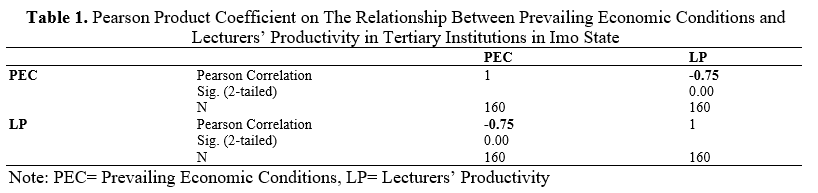
This study examined how prevailing economic conditions relate to productivity, job satisfaction, and job performance of lecturers in public tertiary institutions in Imo State, Nigeria. A correlational survey research design was adopted. Three research questions and three hypotheses guided the study. The population comprised 160 Economics educators from six public tertiary institutions. Four instruments were used to collect data for this study: the Prevailing Economic Condition Questionnaire, Lecturers' Productivity Questionnaire, Job Satisfaction Questionnaire, and Job Performance Questionnaire. Pearson correlation coefficient analyzed relationships, while p-values tested significance. Results revealed that economic conditions had a strongly significant negative relationship with lecturers' productivity (r = -0.75, p < 0.05). Economic conditions showed an insignificant negative weak relationship with job satisfaction (r = -0.10, p > 0.05) and a significant negative moderate relationship with job performance (r = -0.62, p < 0.05). Findings indicate that poor economic conditions significantly impair teaching effectiveness, research output, and instructional delivery. The study links productivity and performance to teaching quality outcomes, addressing implications for curriculum delivery and student learning.
References
Adesina, W. (2021). Against UNESCO's recommendation, Nigeria budgets only N3.6trn of N55.3trn for education in 6 years. Retrieved from www.vanguardngr.com
Akpomi, M. E., Azuibuike, S. S., & Isaac, I. C. A. (2018). Impact of economic recession on job performance of academic staff in higher educational institutions in Rivers State. Nigerian Journal of Business Education, 5(2), 21-31 https://www.academia.edu/118507805/Impact_of_Economic_Recession_on_Job_Performance_of_Academic_Staff_in_Higher_Educational_Institutions_in_Rivers_State
Berkovich, I., Waked, J., Gümüş, S., & DeMatthews, D. (2025). Meeting students’ motivational needs based on Maslow’s framework in challenging contexts: the role of integrated leadership in advancing social justice. International Journal of Leadership in Education, 1-30. https://doi.org/10.1080/13603124.2025.2606994
Bezuidenhout, A. (2021). Job demands and job resources of academics in higher education. Frontiers in Psychology, 12, 631171. https://doi.org/10.3389/fpsyg.2021.631171
Chana, M. U., Ibrahim, A., & Abdulhamid, U. (2022). Influence of work-life-balance and family-life-balance on job performance and satisfaction of business studies teachers in Bauchi State, Nigeria. Innovare Journal of Education, 10(2), 15-19. https://doi.org/10.22159/ijoe.2022v10i2.44331
Cohen, L., Manion, L., & Morrison, K. (2018). Research methods in education (8th ed.). Routledge. https://doi.org/10.4324/9781315456539
Dahuwa, A., Abdu, B., Bello, A., Alkali, M., Bello, I., & Jacob, D. (2020). The impact of economic recession on teaching and learning sciences in higher institutions in Bauchi State north part of Nigeria. Asian Journal of Advanced Research and Reports, 14(2), 18-26 DOI: https://doi.org/10.9734/AJARR/2020/v14i230327
Esomonu, N. P. M., Ikeanumba, B. C., & Eleje, L. I. (2018). Effect of economic recession on tertiary education in Nigeria. International Journal of Scientific and Education Research, 2(2), 126-138. Retrieved from https://www.academia.edu/42735506/EFFECT_OF_ECONOMIC_RECESSION_ON_TERTIARY_EDUCATION_IN_NIGERIA
Friedman, M. (1968). The role of monetary policy. American Economic Review, 58(1), 1-17. https://www.aeaweb.org/aer/top20/58.1.1-17.pdf
Hanushek, E. A. (2011). The economic value of higher teacher quality. Economics of Education Review, 30(3), 466-479. https://doi.org/10.1016/j.econedurev.2010.12.006
Hunter, J. E., & Hunter, R. F. (1984). Validity and utility of alternative predictors of job performance. Psychological Bulletin, 96(1), 72-98. https://home.ubalt.edu/tmitch/645/articles/Hunter%20and%20Hunter%20%201984%20Validity%20and%20Utility.pdf
Issa Gazi, M. A., Islam, M. A., Sobhani, F. A., & Dhar, B. K. (2022). Does job satisfaction differ at different levels of employees? Measurement of job satisfaction among the levels of sugar industrial employees. Sustainability, 14(6), 3564. https://doi.org/10.3390/su14063564
Jackson, C. K., Wigger, C., & Xiong, H. (2021). Do school spending cuts matter? Evidence from the Great Recession. American Economic Journal: Economic Policy, 13(2), 304-335. https://doi.org/10.1257/pol.20180674
Koninga, S., & Dorasamy, N. (2025). Job satisfaction and turnover intentions in South African higher education. Lex Localis-Journal of Local Self-Government, 23(4), 206-225. https://lex-localis.org/index.php/LexLocalis/article/download/800743/1480/21119
Kose, M. A., & Ohnsorege, F. (2020). A decade after the global recession: Lessons and challenges for emerging and developing economies. Washington DC: World Bank. https://doi.org/10.1596/978-1-4648-1544-7
Kraft, M. A., & Lyon, M. A. (2024). The rise and fall of the teaching profession: Prestige, interest, preparation, and satisfaction over the last half century. EdWorkingPapers, 24-944. Retrieved from https://www.edworkingpapers.com/ai24-944
Lawal, O. A., Okereke, E. V., Mande, M. M., Usman, M., & Yusuf, A. (2025). Job satisfaction and lecturers' retention in North-East Nigeria's colleges of education. African Journal of Humanities and Contemporary Education Research, 18(1), 206-225. https://doi.org/10.62154/ajhcer.2025.018.010702
Li, A., Wallace, M., & Hyde, A. (2019). Degrees of inequality: The Great Recession and the college earnings premium in US metropolitan areas. Social science research, 84, 102342. https://doi.org/10.1016/j.ssresearch.2019.102342
Maslow, A. (1943). A theory of human motivation. Psychological Review, 50(4), 370-396. https://doi.org/10.1037/h0054346
Mgaiwa, S. J. (2021). Academics' job satisfaction and intention to quit in Tanzania's public universities. Studies in Higher Education, 46(12), 2594-2609. https://doi.org/10.1080/03075079.2020.1793930
Motowidlo, S. J., & Harrison, J. K. (2012). Job performance. In N. Schmitt & S. Highhouse (Eds.), Handbook of Psychology (pp. 82-103). Wiley. https://doi.org/10.1002/9781118133880.hop212005
Nagler, M., Piopiunik, M., & West, M. R. (2020). Weak markets, strong teachers: Recession at career start and teacher effectiveness. Journal of Labor Economics, 38(2), 453-500. https://doi.org/10.1086/705883
National Bureau of Statistics. (2016). Nigerian GDP report Q2 2016. Abuja: National Bureau of Statistics. https://www.nigerianstat.gov.ng/pdfuploads/GDP%20Q2%202016%20final%20report%2026-08-2016.pdf
National Bureau of Statistics. (2023). Consumer price index report. Retrieved from www.nigerianstat.gov.ng
Oderinde, S. L., Akintunde, O. Y., & Ajala, I. R. (2024). A critical analysis of the impact of work overload on lecturers' well-being: A case of Obafemi Awolowo University, Ile-Ife, Nigeria. International Journal of Qualitative Research, 3(3), 238-249. https://doi.org/10.47540/ijqr.v3i3.1256
Ozili, P. K. (2020). COVID-19 pandemic and economic crisis: The Nigerian experience and structural causes. MPRA Paper No. 99424. Retrieved from https://mpra.ub.uni-muenchen.de/99424/
Ramos-Villagrasa, P. J., Barrada, J. R., Fernández-del-Río, E., & Koopmans, L. (2019). Assessing job performance using brief self-report scales: The case of the individual work performance questionnaire. Journal of Work and Organizational Psychology, 35(3), 195-205. https://doi.org/10.5093/jwop2019a21
Shafiq, M. N. (2010). The effect of an economic crisis on educational outcomes: An economic framework and review of the evidence. Current Issues in Comparative Education, 12(2), 5-13. https://files.eric.ed.gov/fulltext/EJ889563.pdf
Ssesanga, K., & Garrett, R. M. (2005). Job satisfaction of university academics: Perspectives from Uganda. Higher Education, 50(1), 33-56. https://doi.org/10.1007/s10734-004-6346-0
Tien, N. H., Ngoc, N. M., Trang, T. T. T., Duc, L. D. M., & Mai, N. P. (2022). Sustainable Development of Higher Education Institutions in Developing Countries: Comparative Analysis of Poland and Vietnam. Contemporary economics, 16(2). https://www.ceeol.com/search/article-detail?id=1080533
Tijani, A. A., & Abdullahi, N. J. K. (2021). Economic Recession as a Correlate of Teacher Productivity in Kwara State Secondary Schools, Nigeria. Kashere Journal of Education (KJE), 2(1), 129-137 https://journals.fukashere.edu.ng/index.php/kje/article/view/618/527
Times Higher Education. (2023). World University Rankings 2023. Retrieved from https://www.timeshighereducation.com/world-university-rankings/2023
World Bank. (2022). The global education crisis: A path to recovery. Washington, DC: World Bank. https://doi.org/10.1596/978-1-4648-1752-6
Yashodara, L. J., & Indunil, T. M. (2023). Effect of economic crisis on job satisfaction of employees in the banking sector of North Central Province, Sri-Lanka. International Journal of Research Publication and Review, 4(10), 1978-1983. DOI: https://doi.org/10.55248/gengpi.4.1023.102708
Downloads
Published
How to Cite
Issue
Section
License
Copyright (c) 2026 Emmanuel Chukwuma Eze, Ikechukwu Giveson Okafor

This work is licensed under a Creative Commons Attribution-NonCommercial 4.0 International License.