Effect of Inquiry-Based Teaching Method on Senior Secondary School Students’ Achievement in Physics
https://doi.org/10.63081/uejtl.v3i1.148
Inquiry based learning, Problem solving, Critical thinking, STEM
Abstract
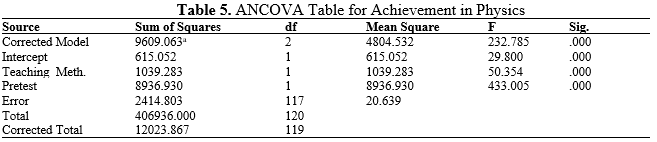
This study investigated the effects of inquiry-based learning (IBL) on the physics achievement of senior secondary II students in Wukari Metropolis, Taraba State. The study adopted a pre-test post-test non-equivalent control group design. Data were collected in order to answer four research questions and test four hypotheses. The sample comprised senior secondary II Physics students (male =55 and female =65 ) drawn from the population of Physics students in Wukari Metropolis. The purposive sampling technique was employed to select two (2) schools from the twenty (20) schools in Wukari Metropolis, and an intact arm of SS II from each of the sampled schools was used. The schools were randomly assigned to control and experimental groups. The instruments used for data collection was A 20-items Physics Achievement Test (PAT) developed by the researcher. The resulting data were collated and analyzed using mean, standard deviation, and ANCOVA. The finding revealed that students taught with inquiry-based learning achieved better results than students taught using the traditional method. There is a significant difference between the mean Physics achievement scores (F(1,117)=50.354, p=0.000, two-tailed) of students taught with IBL and those taught using the traditional method. There is no significant difference in the mean Physics achievement scores of male and female students taught with inquiry based method (F(1,57)=0.296, p=0.589, two-tailed). Based on the sequels to the findings, it is concluded that using inquiry-based learning in teaching increases students' engagement and participation, thereby increasing achievement. It’s recommended that the Ministry of Education should mount periodic training sessions for teachers on the effective utilization of inquiry-based learning in teaching.
References
Abdul, K. & Basuki, W. (2025). Collaborative learning in physics: an overview of group investigative approaches and their impact on learning outcomes. J. Phys.: Conf. Ser. 3139 012084 https://doi.org/10.1088/1742-6596/3139/1/012084
Abu, A. O. (2023). Effect of inquiry method on students’ academic achievement in biology at senior secondary school in Idah, Kogi State. Journal of Science, Technology and Mathematics Pedagogy, 1(1), 30-36. https://jostmp-ksu.com.ng/index.php/jostmp/article/view/37
Adagonye O., Joshua V.H., Anthony M.I., Dube A.D., Shawulu Y. & Bitrus B.A (2024). Science and mathematics education: a catalyst for youths entrepreneurship, economic growth and national development. The Journal of Research and Production, 26 (1), 2-5. https://acjol.org/index.php/nijorep/index
Adegoke, B. A. & Ajadi, T. A. (2016). Structural equation modelling of teachers’ characteristics, skills in teaching and student achievement in secondary school Physics. International Journal of studies in Education in America, 6(2), 2162-6952.
https://doi.org/10.5296/jse.v6i2.8932
Abdi, A. (2014). The effect of inquiry-based learning method on students’ academic achievement in science course.Universal Journal of Educational Research, 2(1): 37-41. https://doi.org/10.13189/ujer.2014.020104
Annan, S. T., Adarkwah, F., Abaka-Yawson, A., Sarpong, P. A., & Santiago, P. K. (2019). Assessment of the inquiry teaching method on academic achievements of students in biology education at Mawuko Girls School, Ho, Ghana. American Journal of EducationalResearch, 7(3), 219–223.https://doi.org/10.12691/education-7-3-5
Ayakeme, D. L. & Kolokolo, F. (2021). Effect of inquiry-based teaching technique and gender on students’ achievement in selected concepts in social studies, in Bayelsa State, Nigeria. Journal of African Social Studies, 2(1), 137-148. ISSN: 2756-4061
Bailey, L. A. (2018). The impact of inquiry-based learning on academic achievement in eighth-grade social studies (Published doctoral dissertation). University of South Carolina, South Carolina, USA https://scholarcommons.sc.edu/etd/4481
Bogador, C. J., Camarao, M. K. G., Matunding, C. G., & Sombria, K. J. F. (2024). Challenges and benefits of inquiry-based learning in physics. International Journal of Multidisciplinary: Applied Business and Education Research, 5(7), 2716-2732. https://doi.org/10.11594/ijmaber.05.07.26
Borovay, L. A., Shore, B. M., Caccese, C., Yang, E., & Hua, O. (2019). Flow, achievement level, and inquiry-based learning. Journal of Advanced Academics, 30(1), 74-106. https://doi.org/10.1177/1932202X18809659
Candido, K. J. O., Gillesania, K. C. C., Mercado, J. C., & Reales, J. M. B. (2022). Interactive simulation on modern physics: a systematic review. International Journal of Multi-disciplinary: Applied Business and Education Research, 3(8), 1452-1462. https://doi.org/10.11594/ijma-ber.03.08.08
Del Fabbro, O. (2022). How to teach machines in artificial intelligence: Technical education in John Dewey, Gilbert Simondon, and machine learning. Education and Culture, 37(2), 24-41. https://doi.org/10.7771/1559-1786.1754
Enser, M. (2021). Powerful geography: A curriculum with purpose in practice. Crown House Publishing Ltd. ISBN: 9781785835421
Fagbenro W. A. & Bulus, T. C. (2024). Modeling of teacher characteristics, skills in teaching, and students’ achievement in secondary school physics. Journals of Educational Research in Developing Area, 5(2), 209-222 https://doi.org/10.47434/JEREDA.5.2.2024.209
Fagbenro, W. A., & Bileya, S. G. (2024). Impact of directed problem-solving education on secondary school students' physics achievement. EAS J Psychol Behav Sci, 6(4), 77-84. https://doi.org/10.36349/easjpbs.2024.v06i04.001
Ghumdia& Adams, A. (2017). Effects of inquiry-based teaching strategies on students’ science process skills acquisition in some selected biology concepts in secondary schools in Borno State. International Journal of Scientific Research, 1(2). http://journalijsr.com/content/2016/IJSR13.pdf
Issaka, M. (2020). Effect of inquiry-based teaching method on students achievement and retention of concepts in integrated science in senior high school. Texila International Journal of Academic Research, 7(2), 78–88. https://doi.org/10.21522/tijar.2014.07.02.art009
Jong, M. S. Y., Chen, G., Tam, V., Hue, M. T., & Chen, M. (2022). Design-based research on teacher facilitation in a pedagogic integration of flipped learning and social enquiry learning. Sustainability, 14(2), 996.https://doi.org/10.3390/su14020996
Kalender, Z. Y., Marshman, E., Schunn, C. D., Nokes-Malach, T. J, & Singh, C. (2020). Damage caused by women’s lower self-efficacy on physics learning. Physical Review Physics Education Research, 16(1):010118. https://doi.org/10.1103/PhysRevPhysEducRes.16.010118
Kessy, S. M. & Irénée, N. (2021). Effects of inquiry-based teaching on students’ academic achievement in biology in lower secondary schools in Ilala–Dar Essalaam-Tanzania. LWATI: A Journal of Contemporary Research, 18(4): 2-14 https://www.ajol.info/index.php/lwati
Kinyota, M. (2020). The status of and challenges facing secondary science teaching in Tanzania: a focus on inquiry-based science teaching and the nature of science. International Journal of Science Education, 42(13), 2126–2144. https://doi.org/10.1080/09500693.2020.1813348
Kokotsaki, D., Menzies, V., & Wiggins, A. (2016). Project- based learning: A review of the literature. Improving Schools, 19(3), 267-277.https://doi.org/10.1177/1365480216659733
Li, G. (2019). The Relationship between Middle School Students' Gender Stereotypes in Physics and Their Academic Achievement in Physics: A Mediated Model. Medical Dissertation, Huazhong Normal University. http://cdmd.cnki.com.cn/article/cdmd-10511-1019205909.htm
Li, Y, & Singh, C. (2021). Effect of gender, self-efficacy, and interest on perception of the learning environment and outcomes in calculus-based introductory physics courses. Physical Review Physics Education Research, 17(1):010143. https://doi.org/10.1103/physrevphyseducres.17.010143
Lucietto, A., Russell, L., & Schott, E. (2018). STEM educators, how diverse disciplines teach. Journal of STEM Education, 19(3), 40-46. https://www.jstem.org/jstem/index.php/JSTEM/article/view/2268
Mäeots, M., Pedaste, M., & Sarapuu, T. (2011, July). Interactions between inquiry processes in a web- based learning environment. In Proceedings of the 2011 IEEE 11th International Conference on Advanced Learning Technologies (pp. 331-335). IEEE. https://doi.org/10.1109/ICALT.2011.103
Malespina, A., Schunn, C. D, & Singh C. (2022). Whose ability and growth matter? Gender, mindset and performance in physics. International Journal of STEM Education, 9(1):28.https://doi.org/10.1186/s40594-022-00342-2
McNamara, R. M. (2022). Inquiry plus literacy: The effect of disciplinary literacy instruction on inquiry-based biology education [Master’s project, Roberts Wesleyan College]. https://doi.org/10.29333/ejmste/14155
Mohammed, I. (2014). Effect of Inquiry-Based Teaching Method on Students Achievement and Retention of Concepts in Integrated Science in Senior High School. Texila International Journal of Academic Research. ISSN: 2520-3088 https://doi.org/10.21522/TIJAR.2014.07.02.Art009
Nurulwati, N., Khairina, L. & Huda, I. (2020). The effect of students’ self-efficacy on the learning outcomes in learning physics. In Journal of Physics: Conference Series 1460(1): 012113. IOP Publishing. https://doi.org/10.1088/1742-6596/1460/1/012113
OECD (2016), PISA 2015 Results (Volume I): Excellence and Equity in Education, PISA, OECD Publishing, Paris. http://dx.doi.org/10.1787/9789264266490-en
Olabiyi, O. S., Ojo, B. A. Y. & Olayinka, F. O. (2021). Managing students' learning challenges through the integration of STEM education for developing 21st-century skills in achanging global workforce. African Journal of Science Technology and Mathematics Education 7(2), 95-100. https://ir.unilag.edu.ng/handle/123456789/11603
Pedaste, M., Mäeots, M., Siiman, L. A., De Jong, T., Van Riesen, S. A., Kamp, E. T., Manoli, C. C., Zacharia, Z. C., & Tsourlidaki, E. (2015). Phases of inquiry- based learning: Definitions and the inquiry cycle. Educational Research Review, 14, 47-61.https://doi.org/10.1016/j.edurev.2015.02.003
Rudra K, (2024). Interactive Multimedia in Teaching Physics Concepts Effectively. Journal of Nepal Physical Society, 10(1):29-36 https://doi.org/10.3126/jnphyssoc.v10i1.72833
Song, J. J., Zuo, B., Wen, F. F. & Jin, Y. S. (2016). Physical gender stereotypes and academic procrastination in Middle school students: A serial mediation model between physics-gender stereotype and academic procrastination. Chinese Journal of Clinical Psychology, 24(3):514-518. https://doi.org/10.16128/j
Smith, J. L. (2004). Understanding the process of stereotype threat: A review of mediational variables and new performance goal directions. Educational Psychology Review, 16:177-206. https://doi.org/10.1023/b:edpr.0000034020.20317.89
Sunday, A., Opara , M. F. & Bardi, I. (2021). Effect of inquiry based learning on secondary schools students’ misconception of science concepts and academic achievement in science. International Journal of Research in Education and Sustainable Development, 1(7), 1-10. https://doi.org/10.46654/IJRESD.1705
Thayer-Bacon, B. (2012). Maria Montessori, John Dewey, and William H. Kilpatrick. Education and Culture, 28(1), 3-20.https://doi.org/10.1353/eac.2012.0001
Turan, K., Ragıp, T., İrfan, A.& Abdullah C. K. (2021).The Effect of inquiry-based learning on academic success: a meta-analysis study. International Journal of Education & Literacy Studies, 9(2):15-23.http://dx.doi.org/10.7575/aiac.ijels.v.9n.2p.15
Ugwuanyi, C.S., Okeke, C.I.O., & Okeke, C.C. (2021). Information and communication technology tool and students’ achievement in Physics: Implication for Evaluation of Library and Information Resources. Library Philosophy and Practice (e-journal). 6097.
https://digitalcommons.unl.edu/libphilprac/6097
Ugwuanyi, C. S., Okeke, C. I. O., &Agboeze, M. U. (2020). Management of test anxiety among pupils in physics using music-based cognitive behavior therapy intervention: implication for community development. Journal of Rational - Emotive and Cognitive - Behavior Therapy, 0123456789. https://doi.org/10.1007/s10942-020-00371-2
Zadok-Gurman, T., Jakobovich, R., Dvash, E., Zafrani, K., Rolnik, B., Ganz, A. B., & Lev-Ari, S. (2021). Effect of inquiry-based stress reduction (IBSR) intervention on well-being, resilience and burnout of teachers during the COVID-19 pandemic. International Journal of Environmental Research and Public Health, 18(7), 3689. https://doi.org/10.3390/ijerph18073689
Downloads
Published
How to Cite
Issue
Section
License
Copyright (c) 2026 Fagbenro W. Ayoola, Judges Ernest Yinjoh

This work is licensed under a Creative Commons Attribution-NonCommercial 4.0 International License.