Socio-Cultural Factors and Students’ Disposition to Behaviour Modification in Akinyele Local Government Area of Oyo State
https://doi.org/10.63081/uejtl.v3i2.152
Behavioural modification, Socio-familial factors, Communication style, Adolescents’ behaviour, Predictive analysis
Abstract
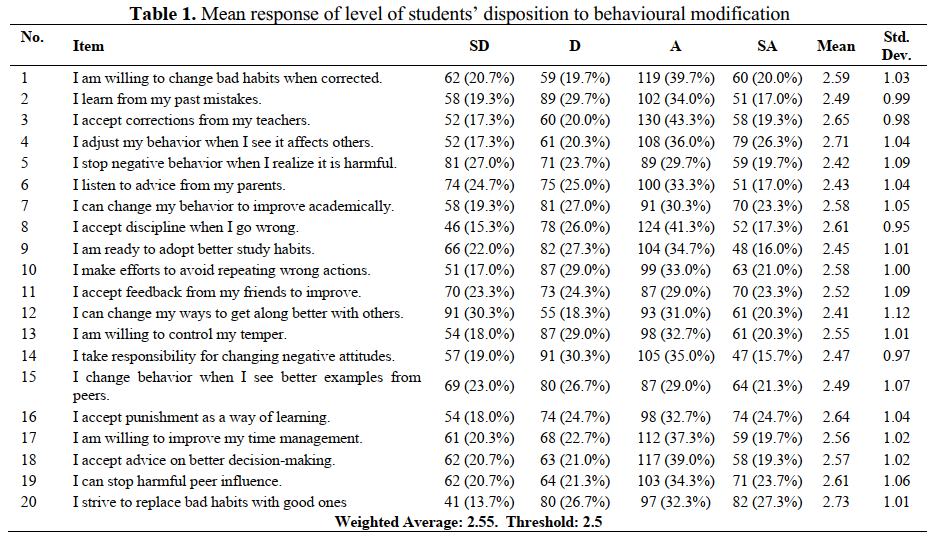
Behaviour modification is essential to students’ social and academic adjustment during adolescence, a period marked by identity formation and emotional instability. However, many students struggle to maintain consistent behaviour in school due to conflicting socio-familial expectations, peer influence, and communication challenges. While previous studies have emphasized external interventions, school environment, and psychological factors, limited attention has been given to the socio-cultural determinants of students’ willingness to modify behaviour. This study investigated socio-familial factors (intergenerational influence and social expectation), communicative factors (communication style), gender role, and cultural adaptation as predictors of students’ disposition toward behavioural modification. Anchored on Social Norms Theory and Parental Socialisation Theory, the study employed a descriptive survey design. Using multistage sampling, 300 secondary school students were selected from schools within the study area. Data were collected using six validated instruments and analysed with descriptive statistics, Pearson Product-Moment Correlation, and Multiple Regression at the 0.05 significance level. Findings showed that students had a generally positive disposition toward behavioural modification (x̄ = 2.55). Intergenerational influence (r = .976), social expectation (r = .988), communication style (r = .990), and gender role (r = .988) had strong, positive, and significant relationships with behavioural disposition, whereas cultural adaptation (r = .095) was not significant. The combined contribution of the predictors was significant (F(5,294) = 4101.347; Adj. R² = .986), explaining 99% of the variance. Communication style (β = .344) was the strongest predictor, followed by social expectation (β = .253), gender role (β = .211), and intergenerational influence (β = .191), while cultural adaptation (β = .002) had no significant effect. The study concludes that intergenerational guidance, perceived social expectations, communication patterns, and gender role norms strongly shape students’ willingness to modify behaviour, whereas broader cultural adaptation has limited direct influence. Schools should therefore strengthen parent-teacher communication, provide gender-sensitive behavioural guidance, and promote positive peer-supported behavioural norms.
References
Adeusi, S. O. (2015). Differential effect of behavioural strategies on maladjusted behaviour in correctional centres in Lagos State, Nigeria. International Journal of Psychology and Counselling. https://doi.org/10.5897/ijpc2015.0304
Ajitoni, S. O., & Omoniyi, T. O. (2024). Stakeholders’ assessment of deviant behaviour among adolescents in Ibadan Southwest Local Government Area of Oyo State. Emmanuel Alayande University of Education Journal, 66–81. (Nigeria). https://doi.org/10.60787/eaued-jms.vol1no1.4
Bicchieri, C., Das, U., Gant, S., & Sander, R. (2021). Examining norms and social expectations surrounding exclusive breastfeeding: Evidence from Mali. Social Norms Theory. (Working paper). arXiv. https://doi.org/10.48550/arXiv.2103.09690
Ef¬fiom, B. E., & Vivian, O. C. (2024). Single parenting and social behaviour of adolescent students in Ukwa West Local Government Area, Abia State, Nigeria. Global Journal of Applied Sciences and Technology.
Ersoy, M., & Öztürk Akçaoğlu, M. (2025). The interplay between social support, acculturative stress, perceived stress and generalized anxiety among international students. Current Psychology. Advance online publication. https://doi.org/10.1007/s12144-025-07798-9
Eze, I. I., Mbachu, C. O., Nwankpa, O., & Onwujekwe, O. (2025). Determinants of young people’s gender norm attitudes related to rights and equity in Southeast Nigeria. Archives of Public Health, 83, Article 65. https://doi.org/10.1186/s13690-025-01550-2
Ezebuchi, O., & Chujor, C. J. (2023). Relationship between parenting styles and adolescents’ at risk sexual behaviour in Etche Local Government Area of Rivers State, Nigeria. European Journal of Training and Development Studies, 10(2), 1–10. https://doi.org/10.37745/ejtds.2014/vol10n2110
Ezeh, C. S., & Samson, A. (2024). Bullying behaviour among in school adolescents in Ibadan, Nigeria: Examining the role of parenting styles and peer pressure. Nigerian Journal of Social Psychology, 7(2) https://www.nigerianjsp.com/index.php/NJSP/article/view/172
Girardini, N. A., Centellegher, S., Passerini, A., Bison, I., Giunchiglia, F., & Lepri, B. (2023). Adaptation of student behavioural routines during COVID 19: A multimodal approach. arXiv preprint. arXiv:2306.08561
Glasser, N. J., Jameson, J., Tung, E., Lindau, S. T., & Pollack, H. A. (2024). Associations of adolescent school social networks, gender norms, and adolescent-to-adult changes in male gender expression with adult substance use. Journal of Adolescent Health, 74(4), 755–763. https://doi.org/10.1016/j.jadohealth.2023.11.018
Gui, H., & Colleagues (2025). Parenting styles and internet addiction in college students: The mediating role of self-esteem and self-control. Frontiers in Psychology, 16. Advance online publication. https://doi.org/10.3389/fpsyg.2025.1555900
Ifeoma, J. N., Casmir, N. N., Anyaorah, G. C., Beluonwu, I., & Nwagbo, C. A. (2023). Parenting, environment, and its role in adolescent transition into adulthood. International Journal of Research and Innovation in Social Science, 7(11), 1891–1898. https://doi.org/10.47772/IJRISS.2023.701145
Jukes, M. C. H., Sitabkhan, Y., & Tibenda, J. J. (2021). Adapting pedagogy to cultural context. RTI Press. https://doi.org/10.3768/rtipress.2021.op.0070.2109
Kazdin, A. E. (2013). Behavior modification in applied settings (7th ed.). Waveland Press.
Lazuka, V., & Elwert, A. (2023). Life-cycle effects of comprehensive sex education. ArXiv preprint. arXiv:2310.11151.
Marqués Sánchez, P., Benítez Andrades, J. A., Calvo Sánchez, M. D., & Arias, N. (2024). The socialization of the adolescent who carries out team sports: A transversal study of centrality with a social network analysis. arXiv preprint. arXiv:2402.09275.
Marqués Sánchez, P., Martínez Fernández, M. C., Benítez Andrades, J. A., Quiroga Sánchez, E., García Ordás, M. T., & Arias Ramos, N. (2024). Adolescent relational behaviour and the obesity pandemic: A descriptive study applying social network analysis and machine learning techniques. arXiv preprint. arXiv:2402.03385
Martínez Ferrer, B., León Moreno, C., Musitu Ferrer, D., Romero Abrio, A., Callejas Jerónimo, J. E., & Musitu Ochoa, G. (2019). Parental socialization, school adjustment and cyber aggression among adolescents. International Journal of Environmental Research and Public Health, 16(20), 4005. https://doi.org/10.3390/ijerph16204005
Mastorci, F., & colleagues. (2024). The transition from childhood into adolescence: Between developmental changes and health vulnerabilities. Children, 11(8), 989. https://doi.org/10.3390/children11080989
Mbachu, C. O., Ozughalu, J., Agu, I. C., Agu, C., & Onwujekwe, O. (2025). Multigenerational attitudes to gender norms on intimate partner violence and the sexual and reproductive health of young people in Nigeria. Scientific Reports, 15, Article 12791. https://doi.org/10.1038/s41598-025-98049-1
McCart, M. R., & others. (2023). Evidence Base Update of Psychosocial Treatments for Adolescents with Disruptive Behavior. Journal of Clinical Child & Adolescent Psychology.
Obiefuna, B. A. C., & Kalu, M. N. (2024). Authoritative parenting style in the light of 1 Samuel 2:18–21: Implications for children’s behavioural and moral development. Journal of African Studies and Sustainable Development, 7(3), https://www.apas.africa/journal_article.php?j=jassd-552
Ofodile, M. C., Akintayo, S. O., Akinyele, O. A., & Ojo, A. O. (2025). Family environment and inconsistent parenting styles on adolescents’ self-esteem among model school students of federal tertiary institutions in Ogun State, Nigeria. International Journal of Research and Innovation in Social Science, 9(8), 622–638. https://doi.org/10.47772/IJRISS.2025.908000049
Omoniyi, T. O. (2024). Multidimensional analyses of streetism based on recent evidence from urban cities in Southwestern Nigeria: Key indicators, causes and perceived age-long interventions. Ibadan Journal of Child Development and Educational Foundations, 5(1), 66–81. https://repository.ui.edu.ng/items/1e9b1dfb-cbe9-40e8-bde9-dd85be918a6b
Omoniyi, T. O. (2023). Situated harmful traditional practices in Southwestern Nigeria: Reduction, pending challenges, and lessons for policy engagements. Nigerian Journal of Applied Psychology, 25. https://repository.ui.edu.ng/items/1f7a26fa-8552-4c9c-b9e6-3a4a0b7129e8
Omoniyi, T. O., & Matthew, A. M. (2023). Correlates of adolescents’ involvement in gambling-related behaviour in Ondo City, Nigeria: Advocating educative programmes to curb the act. International Journal of Continuing and Non-Formal Education, 11(1). https://repository.ui.edu.ng/items/e8c5afcc-8106-44de-9b3f-e3072795fe8f
Rabiu, F. A., Obi, S. N., Wahab, T. K., & Samaila, H. (2024). Parental attitude and antisocial behaviour among senior secondary school adolescents in Lagos, Nigeria. Journal of African Resilience and Advancement Research, 6(2), 1 https://hummingbirdjournals.com/jarar/article/view/234
Scott, H. K., Jain, A., & Cogburn, M. (2023). Behavior modification. In StatPearls. StatPearls Publishing.
Taiwo, M. O., Oyekenu, O., & Hussaini, R. (2023). Understanding how social norms influence access to and utilization of adolescent sexual and reproductive health services in Northern Nigeria. Frontiers in Sociology, 8. https://doi.org/10.3389/fsoc.2023.865499
Ullman, J., Magson, N. R., & Zhong, H. F. (2023). Students’ perceptions of the rules and restrictions of gender at school: A psychometric evaluation of the Gender Climate Scale (GCS). Frontiers in Psychology, 14. https://doi.org/10.3389/fpsyg.2023.1095255
Yin, Z., Zhao, Y., & Wang, Y. (2025). How teachers’ caring behavior impacts the socio cultural adaptability of international students: A chain mediation model. Frontiers in Psychology, 16. https://doi.org/10.3389/fpsyg.2025.1656033
Downloads
Published
How to Cite
Issue
Section
License
Copyright (c) 2026 Timilehin Olayinka OMONIYI

This work is licensed under a Creative Commons Attribution-NonCommercial 4.0 International License.