Professional Development of Teachers in Tribal Gurukula Schools for Promoting Equitable and Inclusive Education
https://doi.org/10.63081/uejtl.v3i2.157
RPwD act, Culturally responsive pedagogy, Equity, Inclusion
Abstract
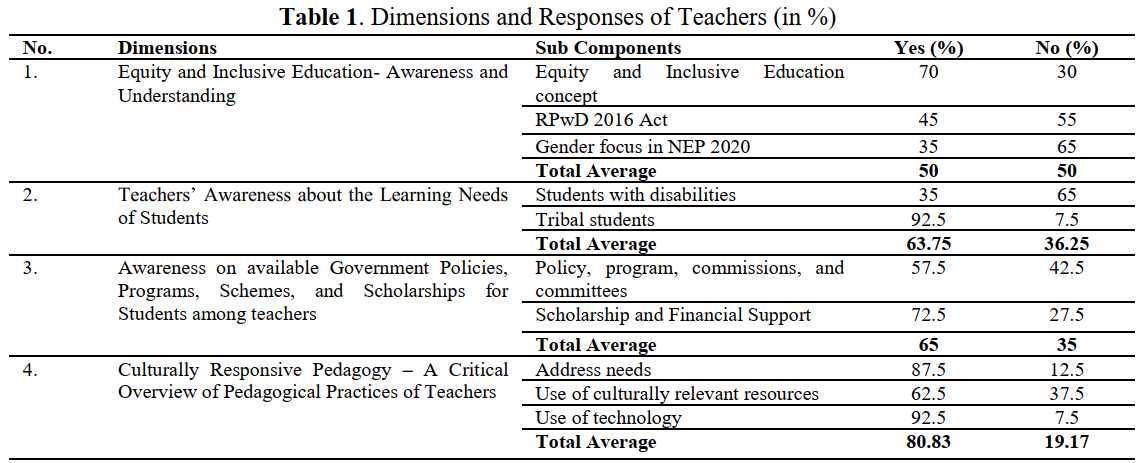
This study, titled "Professional Development of Teachers in Tribal Gurukula Schools for Promoting Equitable and Inclusive Education," explores the perspectives, challenges, and professional development needs of teachers working in Telangana's Tribal Gurukula Schools, operated by the Telangana Tribal Welfare Residential Educational Society (TTWREIS). Using a mixed-methods approach involving surveys and interviews with 40 secondary-Stage teachers, the research reveals that while many teachers are aware of general concepts of equity and inclusion as emphasized in the National Education Policy (NEP) 2020, there is limited understanding of key areas such as the RPwD Act, gender-related concerns, and inclusive pedagogical strategies. Despite familiarity with emerging technologies and recognition of tribal students’ unique learning needs, the use of culturally relevant pedagogy and inclusive teaching resources remains inadequate. Teachers face several challenges, including language barriers, insufficient infrastructure, administrative burdens, and a lack of specific training on tribal culture and inclusive education. Moreover, awareness of government policies, schemes, and support systems is limited. The findings underscore the need for targeted teacher training, improved school infrastructure, culturally responsive pedagogy, and greater systemic support to bridge the gap between policy vision and classroom practice. The study highlights to empower teachers through knowledge, resources, and professional development for achieving equitable and inclusive education for tribal students.
References
Bag, P. (2020). Ethnocentrism in education – Effects of hidden curriculum on tribal students. In R. R. Patil (Ed.), Tribal development in India – Challenges and prospects in tribal education (pp. 42–57). Sage. https://doi.org/10.4135/9789354791710.n3
Bhogle, V. (2025). Tribal Education Ethics and Challenges in India. International Journal of Research and Innovation in Social Science (IJRISS), 9(26). https://doi.org/10.47772/IJRISS.2025.903SEDU0750
Census of India. (2011). Primary census abstract: Scheduled Tribes. Office of the Registrar General & Census Commissioner, India. https://censusindia.gov.in
Chen, F. (2025). Nature and living in Hong Kong kindergartens: Involving local context towards glocalization in early STEM education. In Early Childhood STEM Education in the Asia-Pacific Region (pp. 123–145). Springer. https://doi.org/10.1007/978-981-95-0281-3_8
Clotfelter, C. T., Ladd, H., & Vigdor, J. L. (2007). How and why do teacher credentials matter for student achievement?. Working Paper, 2. https://doi.org/10.3386/w12828
Das, S. (2024). In Lessons from the Ground: Why a Participatory Approach to Learning is Critical to Empowering Tribal Children, American India Foundation (AIF). Retrieved from https://aif.org/lessons-from-the-ground-why-a-participatory-approach-to-learning-is-critical-to-empowering-tribal-children/
Hasnain, N. (1991). Tribal India. Palaka Prakashan.
Hembrom, B. G. (2020). Sociological analysis of educational experiences of Adivasi children. In R. R. Patil (Ed.), Tribal development in India – Challenges and prospects in tribal education (pp. 26–41). Sage. https://doi.org/10.4135/9789354791710.n2
Jabbar, A., Barkati, M., & Ahamad, J. (2024). Tribal education in india: trends, challenges, and strategies. Vidya-a journal of gujarat university, 3(2), 124-127. https://doi.org/10.47413/7b5s2335
Jeffy, S. B., & Cooper, J. E. (2011). Toward a conceptual framework of culturally relevant pedagogy: An overview of the conceptual and theoretical literature. Teacher Education Quarterly, 38(1), 65–84. http://www.jstor.org/stable/23479642
Ladson-Billings, G. (1995). But that’s just good teaching! The case for culturally relevant pedagogy. Theory into Practice, 34(3), 159–165. https://doi.org/10.1080/00405849509543675
Maclean, K., Rist, P., Rassip, W., & Prudames, N. (2024). A practical tool to enable Indigenous enterprise planning and development grounded in culture. Sustainability Science, 19(4), 1205-1220. https://doi.org/10.1007/s11625-023-01459-1
Muzata, K. K., & Chomba, R. M. (2025). Bridging or Limiting Inclusion? Deaf Perspectives on Sign Language Interpretation in Zambian Education. Universal Education Journal of Teaching and Learning, 2(3), 127–137. https://doi.org/10.63081/uejtl.v2i3.99
Palai, P. (2025). Exploring the impact of in-service teacher education on the professional development of elementary teachers: A case study of Odisha. Educational Dimension, 13. https://doi.org/10.55056/ed.983
Panda, R. B., & Singh, M. (2026). Factors Influencing Learning of Children with Specific Learning Disabilities: Exploring the Experience of Teachers. Educational Trend (A Journal of RIE, Ajmer - NCERT), 6(1), P.87-95. https://ejournals.ncert.gov.in/index.php/ET/article/view/5114
Pandanu, R. S. (2025). Ethnomathematics in the Jonggan Art of the Dayak Kanayat’n. Universal Education Journal of Teaching and Learning, 1(3), 57–71. https://doi.org/10.63081/uejtl.v1i3.49
Park, S., & Chan, K. K. H. (2025). Unpacking PCK Relationships and Development in Science Teachers: A Systematic Synthesis of Empirical Research. Review of Educational Research, 00346543251394404. https://doi.org/10.3102/00346543251394404
Putri, A. Y., & Bimantara, A. (2025). Legal Dilemmas in Inclusive Education: Implementation Challenges and Teaching Strategies in Primary Schools. Universal Education Journal of Teaching and Learning, 2(1), 23–31. https://doi.org/10.63081/uejtl.v2i1.42
Phillips, A. J. (2024). Culturally sustaining policymaking in Indigenous communities: Partnering to promote lasting change. Teachers College Press.
Quinn, M. F., & Caudle, L. A. (2025). Embracing culturally relevant computational thinking in the preschool classroom: Leveraging familiar contexts for new learning. Early Childhood Education Journal, 53(2), 393–403. https://doi.org/10.1007/s10643-024-01667-x
Ratri, D. P., Rachmajanti, S., Anugerahwati, M., Laksmi, E. D., & Gozali, A. (2024). Fostering cultural competence: Developing an English syllabus for young learners in the Indonesian EFL context with emphasis on local culture to maintain students‘ identity. Cogent Education, 11(1), 2440177. https://doi.org/10.1080/2331186X.2024.2440177
Reddy, A. A., Maraseni, T., Lahiri, S., Karki, S., Koju, U., Shrestha, A., & Cadman, T. (2024). Perspectives on Forest governance among the indigenous communities of India's Eastern Ghats. Forest Policy and Economics, 169, 103350. https://doi.org/10.1016/j.forpol.2024.103350
Saha, E., & Sarkar, R. (2024). Educational problems and needs of tribal students at the secondary level in Alipurduar District, West Bengal, India. European Journal of Educational Studies, 11(11), 511–524.
Shivagunde, S. (2020). Revisiting policies and need for reform in tribal education. In R. R. Patil (Ed.), Tribal development in India – Challenges and prospects in tribal education. Sage.
Shulman, L. (1987). Knowledge and teaching: Foundations of the new reform. Harvard educational review, 57(1), 1-23. https://doi.org/10.17763/haer.57.1.j463w79r56455411
Sinha, A. (2026). Margins within the margins: The everyday realities of SC/ST students with disabilities in Kolkata's government and government‐aided schools. Support for Learning, 41(2), e70042. https://doi.org/10.1111/1467-9604.70042
Sujatha, K. (2002). Education among scheduled tribes. In R. Govinda (Ed.), India education report (pp. 93–108). Oxford University Press. https://global.oup.com
Times of India. (2024, September 22). Tribal schools switching to English medium have no teachers, lack textbooks. Times of India. Retrieved from https://timesofindia.indiatimes.com/city/pune/tribal-schools-switching-to-english-medium-have-no-teachers-lack-textbooks/articleshow/113572247.cms
UNESCO. (2003). Education in a multilingual world. UNESCO. https://unesdoc.unesco.org
World Bank. (2021). Ending learning poverty: What will it take? India country brief. https://www.worldbank.org
Wreis & Tswries. (2021). English medium policy and outcomes in residential schools: Internal report. https://tgtwreis.in
Yadav, M., Goyal, N., Maun, D., Chandel, A., & Hung, T. H. (2025). PCK in Inclusive Classrooms: how do teachers with PCK address the needs of diverse learners?. In Digital and Cultural Influences on the Development of Pedagogical Content Knowledge (PCK) and TPACK (pp. 319-344). IGI Global Scientific Publishing. https://doi.org/10.4018/979-8-3373-2267-4.ch011
Downloads
Published
How to Cite
Issue
Section
License
Copyright (c) 2026 Balaji Gugulothu

This work is licensed under a Creative Commons Attribution-NonCommercial 4.0 International License.