Impact of Content Quality on Use of e-Learning portals: A Case Study of India’s DIKSHA Platform
https://doi.org/10.63081/uejtl.v3i3.171
E-learning, educational technology, NISHTHA, DIKSHA, e-content quality
Abstract
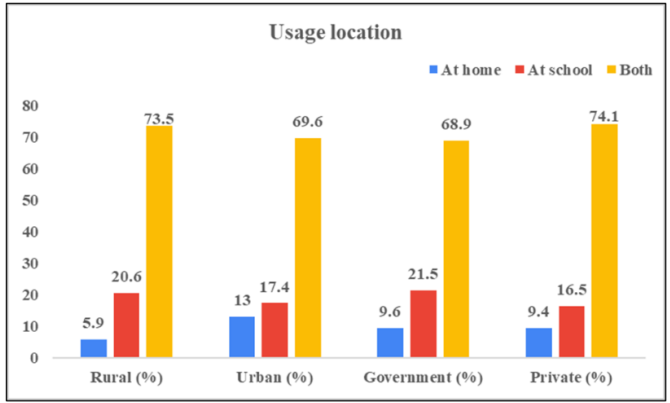
DIKSHA, India's largest government-run, multilingual e-learning platform for school education, provides free access to curriculum-aligned instructional content (e-content) and professional development courses (e-courses) for teachers. This study examines the usage and acceptance of DIKSHA based on a survey of 274 teachers from both government and private schools in India. A comparative assessment of engagement with e-content and e-courses was done by analyzing responses across school management types (government/private), locations (rural/urban), and teaching stages. Data were collected using a questionnaire developed based on the Teaching e-Learning Attitude Related Test (TeLRA) scale and the Unified Theory of Acceptance and Use of Technology (UTAUT) model. Results indicate teachers’ general preference to use the platform in school settings. Government school teachers, particularly in rural areas, report higher use of DIKSHA for classroom teaching and lesson planning, while private school teachers engaged more with capacity-building courses. There is a moderate positive correlation between frequency of the platform use and utilisation of both e-content and e-courses. NISHTHA, the flagship teacher training program plays a pivotal role in adoption of the platform among teachers. These findings indicate the need for differentiated content strategies for teachers from different school types, locality, etc. A targeted outreach to government schools for professional development courses and a similar outreach to private schools for classroom use may further enhance the adoption of the platform. These findings will also inform evidence-based UI/UX enhancements and feature designs.
References
Arbaugh, J. B., & Duray, R. (2002). Technological and structural characteristics, student learning and satisfaction with web-based courses: An exploratory study of two on-line MBA programs. Management Learning, 33(3), 331–347. https://doi.org/10.1177/1350507602333003
Aruleba, K., & Jere, N. (2022). Exploring digital transforming challenges in rural areas of South Africa through a systematic review of empirical studies. Scientific African, 16, Article e01190. https://doi.org/10.1016/j.sciaf.2022.e01190
Bertea, P. (2009). Measuring students' attitude towards e-learning: A case study. In Conference Proceedings of eLearning and Software for Education (eLSE) (Vol. 5, No. 01, pp. 417–424). Carol I National Defence University Publishing House. https://www.semanticscholar.org/paper/b6ab23de0f6960cdffea298316f60ba5b010cc2e
Central Institute of Educational Technology, NCERT. (2015). ePathshala. Retrieved March 2, 2025, from https://epathshala.nic.in
Central Institute of Educational Technology, NCERT. (2017). DIKSHA - A national platform for school education. Retrieved March 2, 2025, from https://diksha.gov.in
Davis, F. D. (1986). A technology acceptance model for empirically testing new end-user information systems: Theory and results. Massachusetts Institute of Technology. https://dspace.mit.edu/handle/1721.1/15192
DeLone, W. H., & McLean, E. R. (1992). Information systems success: The quest for the dependent variable. Information Systems Research, 3(1), 60–95. https://doi.org/10.1287/isre.3.1.60
Ejdys, J. (2021). Factors affecting the adoption of e-learning at university level. WSEAS Transactions on Business and Economics, 18, 313–323. https://doi.org/10.37394/23207.2021.18.32
Ghosh, K. (2022, July). Impact of DIKSHA app as an electronic resource in English language teaching learning process in different Kendriya Vidyalayas' of India. In Journal of Physics: Conference Series (Vol. 2286, No. 1, p. 012019). IOP Publishing. https://doi.org/10.1088/1742-6596/2286/1/012019
Kim, J., & Lee, W. (2011). Assistance and possibilities: Analysis of learning-related factors affecting the online learning satisfaction of underprivileged students. Computers and Education, 57(4), 2395–2405. https://doi.org/10.1016/j.compedu.2011.05.021
Kisanga, D., & Ireson, G. (2016). Test of e-Learning Related Attitudes (TeLRA) scale: Development, reliability and validity study. International Journal of Education and Development Using ICT, 12(1). http://ijede.ca/index.php/jde/article/view/1009
Kumar, R., & Kumari, A. (2023). A study of the implementation of the DIKSHA program in the secondary school education in Koderma District, India. International Journal for Innovative Research in Multidisciplinary Field, 9(01). https://www.ijirmf.com/wp-content/uploads/IJIRMF202301001.pdf
Lee, J.-W. (2010). Online support service quality, online learning acceptance, and student satisfaction. The Internet and Higher Education, 13(4), 277–283. https://doi.org/10.1016/j.iheduc.2010.08.002
Lennox, J., Reuge, N., & Benavides, F. (2021). UNICEF's lessons learned from the education response to the COVID-19 crisis and reflections on the implications for education policy. International Journal of Educational Development, 85, Article 102429. https://doi.org/10.1016/j.ijedudev.2021.102429
Marikyan, D., & Papagiannidis, S. (2023). Unified theory of acceptance and use of technology: A review. In S. Papagiannidis (Ed.), TheoryHub book. https://open.ncl.ac.uk/ (ISBN: 9781739604400)
Martín, A. V. D., & Ramos, J. M. L. (2022). DEIFDC framework: Evaluation of digital education deployment in India in the midst of the Covid-19 pandemic. Social Sciences & Humanities Open, 6(1), Article 100281. https://doi.org/10.1016/j.ssaho.2022.100281
Ministry of Education and NPTEL, IIT Madras. (2016). SWAYAM. Retrieved March 2, 2024, from https://swayam.gov.in
Pynoo, B., Tondeur, J., Van Braak, J., Duyck, W., Sijnave, B., & Duyck, P. (2012). Teachers' acceptance and use of an educational portal. Computers & Education, 58(4), 1308–1317. https://doi.org/10.1016/j.compedu.2011.11.032
Selim, M. (2020, December). Distance learning and its effectiveness in improving literacy, education and skills development for remote population and for overcoming the challenges of COVID 19. In 2020 Sixth International Conference on e-Learning (econf) (pp. 66–71). IEEE. https://doi.org/10.1109/econf51404.2020.9385508
Shaturaev, J. (2022). Financing public education in Indonesia. Архив научных исследований, 2(1). https://www.researchgate.net/publication/359765077
Shen, D., Laffey, J., Lin, Y., & Huang, X. (2006). Social influence for perceived usefulness and ease-of-use of course delivery systems. Journal of Interactive Online Learning, 5(3), 270–282. http://www.ncolr.org/jiol/issues/pdf/5.3.7.pdf
Singh, M., Adebayo, S. O., Saini, M., & Singh, J. (2021). Indian government E-learning initiatives in response to COVID-19 crisis: A case study on online learning in Indian higher education system. Education and Information Technologies, 26(6), 7569–7607. https://doi.org/10.1007/s10639-021-10585-1
Sun, P. C., Tsai, R. J., Finger, G., Chen, Y. Y., & Yeh, D. (2008). What drives a successful e-learning? An empirical investigation of the critical factors influencing learner satisfaction. Computers & Education, 50(4), 1183–1202. https://doi.org/10.1016/j.compedu.2006.11.007
Tawil, S., & Locatelli, R. (2015). Rethinking education: Towards a global common good. UNESCO. https://unevoc.unesco.org/e-forum/RethinkingEducation.pdf
Teo, T., & Wong, S. L. (2013). Modelling key drivers of e-learning satisfaction among student teachers. Journal of Educational Computing Research, 48(1), 71–95. https://doi.org/10.2190/EC.48.1.d
UNESCO. (2017). Ljubljana OER action plan. https://en.unesco.org/sites/default/files/ljubljana_oer_action_plan_2017.pdf
Van Raaij, E. M., & Schepers, J. J. L. (2008). The acceptance and use of a virtual learning environment in China. Computers and Education, 50(3), 838–852. https://doi.org/10.1016/j.compedu.2006.09.001
Venkatesh, V., Morris, M. G., Davis, G. B., & Davis, F. D. (2003). User acceptance of information technology: Toward a unified view. MIS Quarterly, 27(3), 425–478. https://doi.org/10.2307/30036540
Wilkens, L., Haage, A., Lüttmann, F., & Bühler, C. R. (2021). Digital teaching, inclusion and students' needs: Student perspectives on participation and access in higher education. Social Inclusion, 9(3), 117–129. https://doi.org/10.17645/si.v9i3.4125
Downloads
Published
How to Cite
Issue
Section
License
Copyright (c) 2026 Rejaul Karim Barbhuiya, Priya Madhavan

This work is licensed under a Creative Commons Attribution-NonCommercial 4.0 International License.