Flipped Classroom Critical Success Factors Across Science, Technology, Engineering, and Mathematics (STEM) and Non-STEM Disciplines in Senior High School
https://doi.org/10.63081/uejtl.v3i1.183
Flipped classroom implementation, Critical success factors, STEM pedagogy, Disciplinary pedagogical differences, Secondary education
Abstract
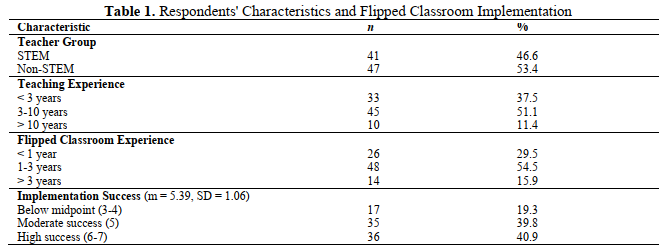
This study examined critical success factors for flipped classroom implementation among 88 senior high school teachers from private schools in Metro Manila, Philippines, with relatively balanced representation across STEM (n=41) and non-STEM (n=47) disciplines. Analysis revealed an emergent Foundation-Quality-Support model wherein technology infrastructure and pedagogical quality factors achieved comparable critical status, indicating necessary technology-pedagogy integration. Ten factors achieved critical success status (≥60% essential), with technology access and reliability rated most critical (75.0%). MANOVA demonstrated marginally significant multivariate effects, with Student Factors showing substantial disciplinary differences. STEM teachers rated student accountability, self-regulation, conceptual-procedural balance, and assessment alignment significantly higher than non-STEM teachers. Thematic analysis confirmed discipline-specific implementation patterns: STEM teachers emphasized technology infrastructure and content complexity management, whereas non-STEM teachers emphasized pedagogical facilitation. Both groups identified student engagement, institutional support, content design quality, and equitable access as universally critical factors. Findings demonstrate that disciplinary differences manifest as variations in degree rather than categorical distinctions, challenging one-size-fits-all approaches and advancing flipped classroom theory toward epistemologically grounded, discipline-responsive implementation frameworks appropriate for well-resourced school contexts.
References
Akçayır, G., & Akçayır, M. (2018). The flipped classroom: A review of its advantages and challenges. Computers & Education, 126, 334-345. https://doi.org/10.1016/j.compedu.2018.07.021
Baig, M. I., & Yadegaridehkordi, E. (2023). Flipped classroom in higher education: A systematic literature review and research challenges. International Journal of Educational Technology in Higher Education, 20, Article 61. https://doi.org/10.1186/s41239-023-00430-5
Bergmann, J., & Sams, A. (2012). Flip your classroom: Reach every student in every class every day. International Society for Technology in Education.
Bhattacharyya, M. (2025). Effectiveness of flipped classroom in higher education: Opportunities and challenges. International Journal of Research and Innovation in Applied Science, 10(10), 1271–1277. https://doi.org/10.51584/IJRIAS.2025.10100000110
Biglan, A. (1973). The characteristics of subject matter in different academic areas. Journal of Applied Psychology, 57(3), 195-203. https://doi.org/10.1037/h0034701
Braun, V., & Clarke, V. (2019). Reflecting on reflexive thematic analysis. Qualitative Research in Sport, Exercise and Health, 11(4), 589-597. https://doi.org/10.1080/2159676X.2019.1628806
Bredow, C. A., Roehling, P. V., Knorp, A. J., & Sweet, A. M. (2021). To flip or not to flip? A meta-analysis of the efficacy of flipped learning in higher education. Review of Educational Research, 91(6), 878-918. https://doi.org/10.3102/00346543211019122
Burce, A. D., & Callo, E. C. (2024). Flipped classroom strategy in promoting critical thinking in social science. World Journal of Advanced Research and Reviews, 22(2), 2111–2137. https://doi.org/10.30574/wjarr.2024.22.2.1638
Bursa, S., & Köse, T. Ç. (2020). The effect of flipped classroom practices on students' academic achievement and responsibility levels in social studies course. The Turkish Online Journal of Distance Education, 21(3), 143–159. https://doi.org/10.17718/tojde.803390
Co, S. J. (2025). Student evaluation of blended learning implementation and faculty performance with online components: A comparative analysis across senior high school grade levels and academic strands. International Journal on Open and Distance e-Learning, 10(2). https://doi.org/10.58887/ijodel.v10i2.287
Creswell, J. W., & Plano Clark, V. L. (2023). Designing and conducting mixed methods research (4th ed.). SAGE Publications.
Erbil, D. G., & Kocabaş, A. (2020). Flipping the 4th grade social studies course in a cooperative way: Effects on academic achievement and motivation. Studies in Educational Evaluation, 66, Article 100878. https://doi.org/10.1016/j.stueduc.2020.100878
Fisher, R., LaFerriere, R., & Rixon, A. (2019). Flipped learning: An effective pedagogy with an Achilles' heel. Innovations in Education and Teaching International, 57(5), 609-620. https://doi.org/10.1080/14703297.2019.1635904
Gonzales, R. R. (2019). Flipped classroom approach: Experiences from a Philippine state university. The Normal Lights, 13(2), 67–89. https://doi.org/10.56278/tnl.v13i2.1386
Hew, K. F., Bai, S., Dawson, P., & Lo, C. K. (2021). Flipped classroom: What we know and what we don't. Educational Research Review, 33, Article 100393. https://doi.org/10.1016/j.edurev.2021.100393
İşçi, T. G., & Yazıcı, K. (2023). The effect of the use of the flipped learning model in the social studies course on the students' academic success and higher-order thinking skills. International E-Journal of Educational Studies, 7(13), 46-64. https://doi.org/10.31458/iejes.1216865
Mengesha, A. K., Simegn, G. L., Chanie, M. G., & Agegn, S. B. (2024). Assessing the effectiveness of flipped classroom teaching in medical education: A quasi-experimental study. BMC Medical Education, 24, Article 6105. https://doi.org/10.1186/s12909-024-06105-7
Mishra, P., & Koehler, M. J. (2006). Technological pedagogical content knowledge: A framework for teacher knowledge. Teachers College Record, 108(6), 1017-1054. https://doi.org/10.1111/j.1467-9620.2006.00684.x
Neumann, R., Parry, S., & Becher, T. (2002). Teaching and learning in their disciplinary contexts: A conceptual analysis. Studies in Higher Education, 27(4), 405-417. https://doi.org/10.1080/0307507022000011525
Oudbier, J., Spaai, G., Timmermans, K., Boerboom, T., Jaarsma, D., Dolmans, D., & Muijtjens, A. (2022). Enhancing the effectiveness of flipped classroom in health science education: A state-of-the-art review. BMC Medical Education, 22, Article 34. https://doi.org/10.1186/s12909-021-03052-5
Polit, D. F., Beck, C. T., & Owen, S. V. (2007). Is the CVI an acceptable indicator of content validity? Appraisal and recommendations. Research in Nursing & Health, 30(4), 459-467. https://doi.org/10.1002/nur.20199
Rockart, J. F. (1979). Chief executives define their own data needs. Harvard Business Review, 57(2), 81-93.
Sablan, J. R., & Prudente, M. (2022). Traditional and flipped learning: Which enhances students' academic performance better? International Journal of Information and Education Technology, 12(1), 54–59. https://doi.org/10.18178/ijiet.2022.12.1.1586
Satparam, J. R., & Apps, T. (2022). A systematic review of the flipped classroom research in K-12: Implementation, challenges and effectiveness. Journal of Education, Management and Development Studies, 2(1), 35-51. https://doi.org/10.52631/jemds.v2i1.71
Senali, M. G., Iranmanesh, M., Ghobakhloo, M., Gengatharen, D., Tseng, M.-L., & Nilsashi, M. (2022). Flipped classroom in business and entrepreneurship education: A systematic review and future research agenda. The International Journal of Management Education, 20(1), Article 100614. https://doi.org/10.1016/j.ijme.2022.100614
Strelan, P., Osborn, A., & Palmer, E. (2020). The flipped classroom: A meta-analysis of effects on student performance across disciplines and education levels. Educational Research Review, 30, Article 100314. https://doi.org/10.1016/j.edurev.2020.100314
Van Alten, D. C. D., Phielix, C., Janssen, J., & Kester, L. (2021). Self-regulated learning support in flipped learning videos enhances learning outcomes. Computers & Education, 158, Article 104000. https://doi.org/10.1016/j.compedu.2020.104000
Wen, Z., & Young, L. (2024). Factors and strategies in the implementation of flipped classrooms among nursing students. Journal of Higher Education Research, 12(1), 121–146. https://doi.org/10.70228/YJHER2024003
Yang, J., & Balinas, J. (2025). Flipped classroom in China: A review of research, implementation, and challenges. Comparative Education Research, 3(1), 1-25. https://doi.org/10.54097/sfxbz957
Downloads
Published
How to Cite
Issue
Section
License
Copyright (c) 2026 Stephen Jay Co, Arcturus Mancera

This work is licensed under a Creative Commons Attribution-NonCommercial 4.0 International License.