A Comparative Analysis of Children’s Learning Motivation Between Conventional Literacy Learning and a Learning-by-Doing Approach in a Community Literacy Program
https://doi.org/10.63081/uejtl.v3i2.191
Learning motivation, Community literacy, Experiential learning, Non-formal education, Literacy education
Abstract
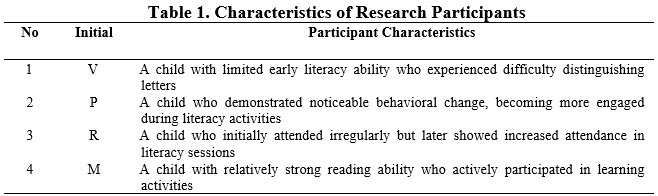
Children’s literacy development in non-formal educational settings is influenced not only by access to reading materials but also by learners’ motivation to participate in literacy activities. In many community literacy programs, learning practices are often limited to access-based approaches that emphasize reading exposure with relatively limited opportunities for active participation. Such conditions may affect children’s engagement and motivation in literacy activities. This study aims to conduct a comparative analysis of children’s learning motivation between conventional literacy learning and a learning-by-doing approach implemented at Teras Baca Taman Gantung, a community-based literacy program. This study employed a qualitative descriptive design with a comparative perspective. The participants consisted of four primary school–aged children who regularly attended literacy activities in the program. Data were collected through attendance documentation, direct observation of students’ learning behaviors, and semi-structured interviews. Observational data were coded to identify behavioral patterns related to learning motivation, including off-task behavior, passive participation, and active engagement. The findings indicate that students demonstrated lower learning motivation during conventional literacy activities, reflected in irregular attendance and off-task behaviors. In contrast, the learning-by-doing approach was associated with higher levels of participation and more active engagement during literacy sessions. These findings highlight the importance of participatory learning environments in supporting children’s engagement in community literacy initiatives. The results suggest that experiential learning activities can foster stronger learning motivation in community-based literacy programs.
References
Arbuliente, A. (2024). Parental Involvement of Economically Challenged Students in the New Normal Education. Journal of Interdisciplinary Perspectives, 2(1), 121-133. https://doi.org/10.69569/jip.2024.0015
Dewey, J. (1938). Experience and Education. The Educational Forum, 50(3), 241–252. https://doi.org/10.1080/00131728609335764
Epstein, J. L. (2011). School, Family, and Community Partnerships: Preparing Educators and Improving Schools (2nd ed.). Routledge. https://doi.org/10.4324/9780429494673
Freeman, S., Eddy, S. L., McDonough, M., Smith, M. K., Okoroafor, N., Jordt, H., & Wenderoth, M. P. (2014). Active learning increases student performance in science, engineering, and mathematics. Proceedings of the National Academy of Sciences. 111 (23) 8410-8415, https://doi.org/10.1073/pnas.1319030111
House, J. S. (1981). Work Stress and Social Support. Addison-Wesley.
Hsieh, T. L. (2014). Motivation matters? The relationship among different types of learning motivation, engagement behaviors and learning outcomes of undergraduate students in Taiwan. Higher Education, 68(3), 417-433. https://doi.org/10.1007/s10734-014-9720-6
Inayati, P. N., Arbarini, M., & Shofwan, I. (2024). Implementation of Literacy Learning for Students in Increasing Interest in Reading in The Matja Bhaca Community. Lembaran Ilmu Kependidikan, 53(1), 107-119. https://doi.org/10.15294/lik.v53i1.3873
Lave, J., & Wenger, E. (1991). Situated Learning: Legitimate Peripheral Participation. Cambridge: Cambridge University Press.
McDonald, D., Holmes, Y., & Prater, T. (2020). The Rules of Engagement: A Test of Instructor Inputs and Student Learning Outcomes in Active versus Passive Learning Environments. E-Journal of Business Education and Scholarship of Teaching, 14(1), 25-39. https://eric.ed.gov/?id=EJ1276424
Neuman, S. B., & Celano, D. (2001). Access to Print in Low-Income and Middle-Income Communities: An Ecological Study of Four Neighborhoods. Reading Research Quarterly, 36 (1), 8–26. https://doi.org/10.1598/RRQ.36.1.1
Niiranen, S. (2021). Supporting the development of students’ technological understanding in craft and technology education via the learning-by-doing approach. International Journal of Technology and Design Education, 31(1), 81-93. https://doi.org/10.1007/s10798-019-09546-0
Noreen, S., & Iqbal, Z. (2024). Challenges of participation in adult basic literacy: Practical implications for practitioners. Journal of Adult and Continuing Education, 30(2), 551-571.
OECD. (2019). PISA 2018 Results (Volume I): What Students Know and Can Do. OECD Publishing.
Patil, M. S., & Kamerikar, U. A. (2020). Learning by doing through project based active learning technique. Journal of Engineering Education Transformations, 33, 125-129. https://doi.org/10.16920/jeet/2020/v33i0/150080
Pereira, A., & Ortiz, K. Z. (2022). Language skills differences between adults without formal education and low formal education. Psicologia: Reflexão e Crítica, 35, 4. https://doi.org/10.1186/s41155-021-00205-9
Raza, S. A., Qazi, W., & Umer, B. (2020). Examining the impact of case-based learning on student engagement, learning motivation and learning performance among university students. Journal of Applied Research in Higher Education, 12(3), 517-533. https://doi.org/10.1108/JARHE-05-2019-0105
Ribeiro, L. M., Cunha, R. S., Silva, M. C. A. E., Carvalho, M., & Vital, M. L. (2021). Parental involvement during pandemic times: Challenges and opportunities. Education Sciences, 11(6), 302. https://doi.org/10.3390/educsci11060302
Ryan, R. M., & Deci, E. L. (2020). Intrinsic and extrinsic motivation from a self-determination perspective. Contemporary Educational Psychology. 61 101–860 https://doi.org/10.1016/j.cedpsych.2020.101860
Sabatini, J., Graesser, A. C., Hollander, J., & O'Reilly, T. (2023). A framework of literacy development and how AI can transform theory and practice. British Journal of Educational Technology, 54(5), 1174-1203. https://doi.org/10.1111/bjet.13342
Setiajaya, D., Efriliana, H., Aonilah, I., & Hasibuan, A. K. (2022). Evaluation of the community literacy program family planning village. Journal of Nonformal Education and Community Empowerment, 6(1), 1-9. https://doi.org/10.15294/jnfc.v6i1.3762
Sheehan‐Holt, J. K., & Smith, M. C. (2000). Does basic skills education affect adults' literacy proficiencies and reading practices?. Reading Research Quarterly, 35(2), 226-243. https://doi.org/10.1598/RRQ.35.2.2
Skulmowski, A. (2024). Learning by doing or doing without learning? The potentials and challenges of activity-based learning. Educational Psychology Review, 36(1), 28. https://doi.org/10.1007/s10648-024-09869-y
Sugarman, L. (1987). Experiential Learning: Experience as the Source of Learning and Development. Prentice Hall International. 8 (4) 359-360. https://doi.org/10.1002/job.4030080408
Susanto, Desrani, A., Ritonga, A. W., & Lubis, M. (2023). Learning by Doing: A Teaching Paradigm for Active Learning in Islamic High School. Journal of Education and e-learning Research, 10(4), 793-799. https://doi.org/10.20448/jeelr.v10i4.5224
Senechal, M., & LeFevre, J.-A. (2002). Parental Involvement in the Development of Children’s Reading Skill: A Five-Year Longitudinal Study. Child Development, 73(2), 445–460. http://www.jstor.org/stable/3696368
Wlodkowski, R. J., & Ginsberg, M. B. (2017). Enhancing adult motivation to learn: A comprehensive guide for teaching all adults. John Wiley & Sons.
Downloads
Published
How to Cite
Issue
Section
License
Copyright (c) 2026 Putri Kiki Sushella, Sardin, Yanti Shantini, Riska Trinanda

This work is licensed under a Creative Commons Attribution-NonCommercial 4.0 International License.