Community-Based Learning Practices in a Down Syndrome Family (POTADS) Community
https://doi.org/10.63081/uejtl.v3i1.192
Community-based learning, Family involvement, Down syndrome, Community education
Abstract
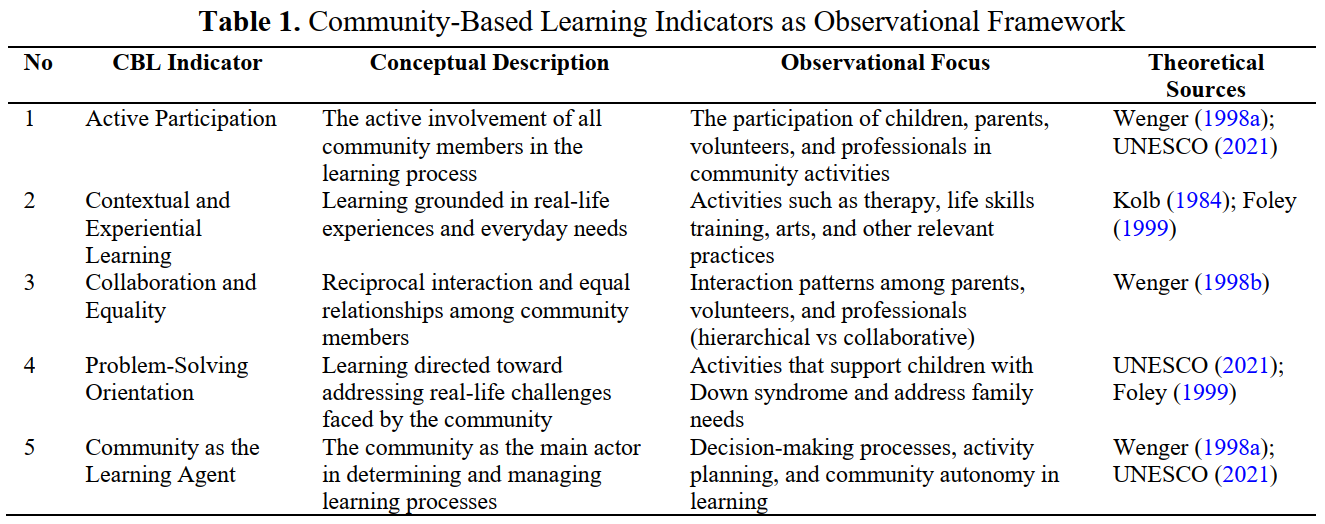
This study aims to identify the implementation of Community-Based Learning (CBL) within the POTADS West Java community as a family-based community of children with Down syndrome. The study employed a qualitative descriptive approach with an observational design, based on four direct observations supported by documentation of community activities. The analysis was guided by key CBL indicators, including active participation, contextual and experiential learning, collaboration and equality, problem-solving orientation, and the community as the learning agent. The findings reveal that all CBL indicators were consistently manifested across various community activities. The learning process was participatory, grounded in real-life experiences, and involved collaborative interactions among children, parents, volunteers, and professionals. In addition, the activities were oriented toward addressing real challenges faced by community members and were collectively managed by the community itself. These findings confirm that CBL is not merely a theoretical construct but is empirically implemented within disability-oriented communities. Furthermore, the study highlights the central role of family involvement in strengthening the implementation of CBL within community contexts. Thus, the POTADS West Java community represents a concrete example of inclusive, contextual, and sustainable community-based learning. This study contributes to the understanding of CBL implementation in family-based community settings and emphasizes the importance of integrating family roles in the development of adaptive and inclusive non-formal education.
References
Abdullah, N., binti Abdullah, N. S., binti Yussof, R., binti Razak, N. N., binti Romly, N., & bin Azmi, M. S. F. (2023, October). Fostering independence: Perlis Special Teens Centre engages families, communities, and stakeholders. In Proceedings of International Conference on Special Education (Vol. 5). https://publication.seameosen.edu.my/index.php/icse/article/view/367
Ahmad, M. S., & Talib, N. B. A. (2015). Empowering local communities: decentralization, empowerment and community driven development. Quality & Quantity, 49(2), 827-838. https://doi.org/10.1007/s11135-014-0025-8
Akman, J., Bitting, K. S., & Merricks, J. A. (2026). Do Community-Based Learning Experiences in STEM Encourage Students From Historically Underrepresented Backgrounds to Pursue STEM? A Mixed-Methods Systematic Review. Journal of Experiential Education, 10538259261421544. https://doi.org/10.1177/10538259261421544
Ali, M. M., & Skandrani, S. R. (2026). Education and poverty: The case of street-children in urban areas of Pakistan. International Journal of Educational Development, 121, 103499. https://doi.org/10.1016/j.ijedudev.2026.103499
Basualto, P., Senevirathna, A., Seth, A., Dimitropoulos, G., & Zwicker, J. (2025). Service integration for children with neurodevelopmental disabilities with support needs and their families: qualitative study. International Journal of Integrated Care (IJIC), 25(S2). https://doi.org/10.5334/ijic.NACIC24140
Batz, R., & Yadav, A. (2024). Parents’ experiences navigating early intervention and early childhood special education services: A qualitative metasynthesis. Journal of Early Intervention, 46(1), 19-38. https://doi.org/10.1177/10538151231164902
Belete, S., Duke, C., Hinzen, H., Owusu-Boampong, A., & Khau, H. P. (2022). Community Learning Centres (CLCs) for Adult Learning and Education (ALE): development in and by communities. International Review of Education, 68(2), 259-290. https://doi.org/10.1007/s11159-022-09954-w
Callanan, M., Cervantes, C., & Loomis, M. (2011). Informal learning. Wiley Interdisciplinary Reviews: Cognitive Science, 2(6), 646-655. https://doi.org/10.1002/wcs.143
Craig, K. P., Riggan, K. A., Rubeck, S., Meredith, S. H., Allyse, M. A., & Michie, M. (2023). Never “totally prepared”: Support groups on helping families prepare for a child with a genetic condition. Journal of community genetics, 14(3), 319-327. https://doi.org/10.1007/s12687-023-00646-y
Dale, B. A., Ogle, L. N., Ruble, L. A., & Azad, G. F. (2025). Dyadic mechanisms of effect in home–school consultation: Evidence from two school-based consultation models. School Psychology International, 46(2), 115-134. https://doi.org/10.1177/01430343241283025
Diemert, R. M. (2023). Exploring International Baccalaureate students' experiences of community-based learning: an interpretive case study (Doctoral dissertation, University of British Columbia). https://dx.doi.org/10.14288/1.0433097
Dushkova, D., & Ivlieva, O. (2024). Empowering communities to act for a change: A review of the community empowerment programs towards sustainability and resilience. Sustainability, 16(19), 8700. https://doi.org/10.3390/su16198700
Finger, M., & Karcz, K. (2025). Helping people with brain injuries find their way through health and social services in Switzerland. European Journal of Public Health, 35(Supplement_4), ckaf161.422. https://doi.org/10.1093/eurpub/ckaf161.422
Foley, G. (1999). Learning in Social Action: a contribution to understanding informal education. Londong, Zed Books.
Forslund, T., Melander, S., Springer, L., Stolpe, L. D., & Jöreskog, K. (2025). Adapted Support to Families Headed by Parents With Intellectual Disability Through Support to Practitioners: SUF Resource Centre and Examples From Uppsala, Sweden. Journal of Applied Research in Intellectual Disabilities, 38(5), e70136. https://doi.org/10.1111/jar.70136
Freire, P. (1970). Cultural action for freedom. Harvard Educational Review, 40(2), 225–243. https://doi.org/10.17763/haer.40.2.q7n227021n148p26
Glassman, M., Kuznetcova, I., Peri, J., & Kim, Y. (2021). Cohesion, collaboration and the struggle of creating online learning communities: Development and validation of an online collective efficacy scale. Computers and Education Open, 2, 100031. https://doi.org/10.1016/j.caeo.2021.100031
Gordon, L., Hastry, M., Bate, A., Gordon, K., Greaves, E., Dimitriadou, S., ... & Basu, A. P. (2025). Hospital in-reach family-centred social prescribing pilot for children with neurodisability: mixed methods evaluation with social return on investment analysis. BMC Health Services Research, 25(1), 176. https://doi.org/10.1186/s12913-025-12329-0
Graff, S. C. (2021). Co-investigation and co-education in ‘family as faculty’approaches: A repositioning of power. Theory Into Practice, 60(1), 39-50. https://doi.org/10.1080/00405841.2020.1829380
Harty, A. A. (2024). Inovasi Layanan Pendidikan melalui Deli Serdang Mewujudkan Impian Sekolah Peduli Keluarga dan Anak Berkebutuhan Khusus (Demi Sepeda Bagus) di Kecamatan Tanjung Morawa. (Undergraduate theses, Universitas Sumatera Utara). https://repositori.usu.ac.id/handle/123456789/97743
Hayward, S., Hayes, D., Griffiths, T., Bloch, S., & Clarke, M. T. (2025). Developing collaborative relationships between professionals and parents of children with neurodisability: A meta-narrative review. Current Developmental Disorders Reports, 12(1), 16. https://doi.org/10.1007/s40474-025-00327-0
Jeter, K., & Hardin, M. P. (2024). Parenting children with Down syndrome: A systemic look at the disability experience. Australian and New Zealand Journal of Family Therapy, 45(3), 325-335. https://doi.org/10.1002/anzf.1582
Karcz, K., Finger, M., Brünisholz, M., Fritsche, P., Geisen, T., Keller, Y., ... & Zimmermann-Gerster, B. (2025). From fragmentation to coordination: sustainable service pathways for persons with brain injury. European Journal of Public Health, 35(Supplement_4), ckaf161-1976. https://doi.org/10.1093/eurpub/ckaf161.1976
Kervick, C. (2017). Parents are the experts: Understanding parent knowledge and the strategies they use to foster collaboration with special education teams. Journal of the American Academy of Special Education Professionals, 62, 82. https://doi.org/10.64546/jaasep.337
Kolb, D. A. (1984). Experiential learning. Journal of Experiential Learning, 7(3), 20–38. https://doi.org/10.1177/105382598700900104
Lave, J., & Wenger, E. (1991). Situated learning. Educational Researcher, 20(4), 30–35. https://doi.org/10.3102/0013189X020004030
Li, C., Burke, M., & Rossetti, Z. (2026). From Belief to Action: The Role of Disability Connectedness and Moral Conviction in Parent Advocacy Activities. Journal of Developmental and Physical Disabilities, 1-16. https://doi.org/10.1007/s10882-025-10046-4
Lo, L., & Xu, Y. (Eds.). (2019). Family, school, and community partnerships for students with disabilities. Springer. https://doi.org/10.1007/978-981-13-6307-8
Means, J. M. (2023). Perception of collaboration between parents and teachers of students with special needs regarding the individual education plan (IEP). Journal of Social Sciences and Business, 2(1), 43-60. https://doi.org/10.5281/zenodo.8152159
Mendoza-García, A., Aparicio, A., Arango, P. S., & Tenorio, M. (2025). Exploring the feasibility and effectiveness of a naturalistic family centered intervention to enhance early interactions in toddlers with Down syndrome. Scientific Reports, 15(1), 12077. https://doi.org/10.1038/s41598-025-96803-z
Mooren, T., Rabaia, Y., Mitwalli, S., Reiffers, R., Koenen, R., & de Man, M. (2018). The Multi-Family Approach to facilitate a family support network for Palestinian parents of children with a disability: A descriptive study. The Lancet, 391, S49. https://doi.org/10.1016/S0140-6736(18)30415-X
Mulvale, G., Green, J., Robert, G., Larkin, M., Vackerberg, N., Kjellström, S., ... & Craythorne, S. L. (2024). Adopting, implementing and assimilating coproduced health and social care innovations involving structurally vulnerable populations: findings from a longitudinal, multiple case study design in Canada, Scotland and Sweden. Health research policy and systems, 22(1), 42. https://doi.org/10.1186/s12961-024-01130-w
Prest, K., Harden, A., Barnicot, K., & Heys, M. (2025). A coadapted community-based participatory group programme for parents/carers of children with complex neurodisability (Encompass-2): A pilot and feasibility study protocol. Pilot and Feasibility Studies, 11(1), 59. https://doi.org/10.1186/s40814-025-01619-3
Proctor, K., Patel, M., Krishna, D., Venkatachalapathy, N., Brien, M., & Langlois, S. (2024). A capacity-building intervention for parents of children with disabilities in rural South India. Research in Developmental Disabilities, 150, 104766. https://doi.org/10.1016/j.ridd.2024.104766
Thompson, J. R., Wehmeyer, M. L., Shogren, K. A., & Seo, H. (2017). The supports paradigm and intellectual and developmental disabilities. In Handbook of positive psychology in intellectual and developmental disabilities: Translating research into practice (pp. 23-35). Cham: Springer International Publishing. https://doi.org/10.1007/978-3-319-59066-0_3
UNESCO. (2021). AI and education: Guidance for policy-makers. UNESCO Publishing.
Wahab, A. A., & Monoto, E. M. M. (2018). Engaging and empowering parents of children with down syndrome-The role of parents support group. IIUM Medical Journal Malaysia, 17(1). https://doi.org/10.31436/imjm.v17i1.1018
Walsh, M. M., Van Deusen, K., Pinks, M. E., Ceci, B., Hepburn, S., Riggs, N. R., ... & Fidler, D. J. (2024). Parent Perspectives on Parent‐Mediated Intervention for Young Children With Down Syndrome. Journal of Applied Research in Intellectual Disabilities, 37(6), e13307. https://doi.org/10.1111/jar.13307
Wenger, E. (1998a). Communities of Practice. Cambridge University Press.
Wenger, E. (1998b). Communities of practice. Systems Thinker, 9(5), 2–3. https://doi.org/10.1007/978-1-84882-311-2
Whitbread, K. M., Bruder, M. B., Fleming, G., & Park, H. J. (2007). Collaboration in special education: Parent—Professional training. Teaching Exceptional Children, 39(4), 6-14. https://doi.org/10.1177/004005990703900401
Witter, S., D'Ambruoso, L., Van Der Merwe, M., Hove, J., Nkalanga, N., Mabetha, D., ... & Tollman, S. (2025). Community and health systems learning: critical realist evaluation of the VAPAR ‘learning platform’in rural South Africa 2015-25. Wellcome open research, 10, 135. https://doi.org/10.12688/wellcomeopenres.23381.2
Ziervogel, G., Cowen, A., & Ziniades, J. (2016). Moving from adaptive to transformative capacity: Building foundations for inclusive, thriving, and regenerative urban settlements. Sustainability, 8(9), 955. https://doi.org/10.3390/su8090955
Zimmerman, M. A. (1995). Psychological empowerment. American Journal of Community Psychology, 23(5), 581–599. https://doi.org/10.1007/BF02506983
Downloads
Published
How to Cite
Issue
Section
License
Copyright (c) 2026 Riska Trinanda, Jajat S Ardiwinata, Yanti Shantini, Elih Sudipermana, Putri Kiki Sushella

This work is licensed under a Creative Commons Attribution-NonCommercial 4.0 International License.