Spatial Access, Household Income, and The Geography of Educational-Resource Affordability in Oyo Town, Nigeria
https://doi.org/10.63081/uejtl.v3i3.208
Spatial access, Household income, Educational affordability, Urban inequality, Oyo Town, Nigeria
Abstract
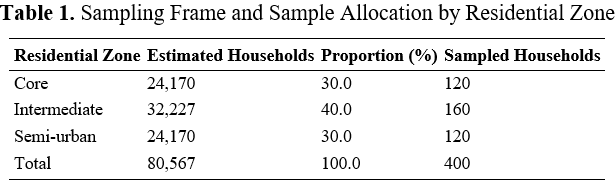
Educational inequality in Nigerian cities persists despite expanded access to schooling, largely because of the rising cost burden of learning materials such as textbooks, uniforms, and stationery. This study examines how spatial accessibility and household income jointly shape the affordability of educational resources in Oyo Town, Nigeria, drawing on Central Place Theory and the Effectively Maintained Inequality (EMI) framework. A concurrent mixed-methods design was used, combining a structured household survey of four hundred households across core, intermediate, and semi-urban zones with interviews of fifty educational-material traders. Quantitative data were analysed using descriptive statistics, chi-square tests of association, and multiple linear regression; qualitative data were analysed thematically. Regression results indicate that household income (Beta = 0.31, p < 0.001) and market proximity (Beta = 0.27, p = 0.015) are significant predictors of affordability, jointly explaining 42% of the variance in affordability scores (R squared = 0.42, Adjusted R squared = 0.39, F(3, 396) = 18.67, p < 0.001); household size was not a significant predictor (Beta = -0.05, p = 0.212). Households in peripheral zones reported higher effective costs, associated with transport expenditure and reduced market competition. The findings support treating educational-resource affordability as a spatially embedded outcome rather than a purely economic one, and the study recommends combining income-support measures with spatial interventions such as decentralised market provision and improved transport infrastructure.
References
Anand, P., Behrman, J. R., Dang, H. A. H., & Jones, S. (2022). Decomposing learning inequalities in East Africa: how much does sorting matter?. The World Bank Economic Review, 36(1), 219–243. https://doi.org/10.1093/wber/lhab014
Belay, T., De Simone, M. E., Parajuli, D., Okunola, O. O., Dahal, M., Ajiboye, A. G., Pradhan, E., Chugunov, D., Isser, D., & Nweje, I. J. (2024). Human capital public expenditure and institutional review: An analysis of financing and governance constraints for the delivery of basic education and primary health care in Nigeria. World Bank.
Boterman, W., Musterd, S., Pacchi, C., & Ranci, C. (2019). School segregation in contemporary cities: Socio-spatial dynamics, institutional context and urban outcomes. Urban Studies, 56(15), 3055–3073. https://doi.org/10.1177/0042098019868377
Braun, V., and Clarke, V. (2006). Using thematic analysis in psychology. Qualitative Research in Psychology, 3(2), 77–101.
Christaller, W. (1966). Central places in southern Germany (C. W. Baskin, Trans.). Prentice-Hall. (Original work published 1933)
Creswell, J. W., & Plano Clark, V. L. (2018). Designing and conducting mixed methods research (3rd ed.). SAGE.
Engle, P. L., & Black, M. M. (2008). The effect of poverty on child development and educational outcomes. Annals of the New York Academy of Sciences, 1136(1), 243–256.
Hotelling, H. (1929). Stability in competition. The Economic Journal, 39(153), 41–57.
Ilie, S., & Rose, P. (2016). Is equal access to higher education in South Asia and sub-Saharan Africa achievable by 2030? Higher Education, 72, 435-455.
Jiang, C., Wan, G., Shi, S., Zhi, Y., & Wang, Z. (2026). The power of digital and traditional cultural capital: unpacking the association between family material deprivation and academic performance in eight countries. Children and Youth Services Review, 181, 108747. https://doi.org/10.1016/j.childyouth.2025.108747
Kaptan, O., & Kocabaş, İ. (2025). Neighborhoods and schools: The socio-spatial dynamics of educational achievement in Amsterdam. Educational Process: International Journal, 15(1), Article e2025149. https://doi.org/10.22521/edupij.2025.149
Lucas, S. R. (2001). Effectively maintained inequality: Education transitions, track mobility, and social background effects. American Journal of Sociology, 106(6), 1642–1690.
McKeever, M. (2017). Educational inequality in apartheid South Africa. American Behavioral Scientist, 61(1), 114–131.
Muyaka, J., & Wafula, C. (2026). Growth of private higher education in Somalia and reflections on the emerging risks and equity concerns. Discover Education, 5(1), Article 72. https://doi.org/10.1007/s44217-026-01972-2
National Population Commission. (2018). Nigeria population projections: 2016-2020. National Population Commission.
Páez, A., Scott, D. M., & Morency, C. (2012). Measuring accessibility: Positive and normative implementations of various accessibility indicators. Journal of Transport Geography, 25, 141–153. https://doi.org/10.1016/j.jtrangeo.2012.03.016
Reardon, S. F. (2019). Educational opportunity in early childhood: Inequality and implications. Educational Researcher, 48(8), 459–472. https://doi.org/10.3102/0013189X19882958
UNESCO. (2021). Global education monitoring report 2021/2: Non-state actors in education: Who chooses? Who loses? UNESCO.
van de Werfhorst, H. G., & Mijs, J. J. B. (2010). Achievement inequality and the institutional structure of educational systems: A comparative perspective. Annual Review of Sociology, 36, 407–428. https://doi.org/10.1146/annurev.soc.012809.102538
Downloads
Published
How to Cite
Issue
Section
License
Copyright (c) 2026 Oladiran Paul Olaniyi; Aminat Folakemi Adeleke

This work is licensed under a Creative Commons Attribution-NonCommercial 4.0 International License.