Validation of a Foundry Craft Practical Skills Assessment Instrument (FCPSAI) in Nigerian Technical Colleges Using Content Validity Index
https://doi.org/10.63081/uejtl.v3i3.211
Content validity index, Foundry craft, Practical skills assessment, Technical and vocational , TVET, International TVET Quality
Abstract
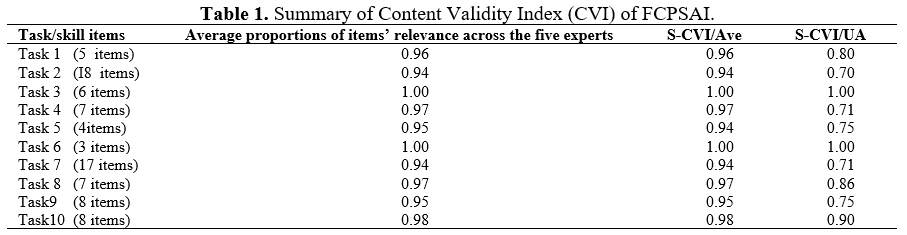
This study evaluates the content validity of the Foundry Craft Practical Skills Assessment Instrument (FCPSAI) developed for technical colleges in Nigeria. The content validation of a foundry craft instrument using the CVI was conducted through a three -stage methodology. The first stage involved defining the instrument and its core aspects needing validation; the second stage focused on selecting a questionnaire as the validation tool. The third stage involved data collection, where validators completed the questionnaire and provided their assessments. A systematic validation process was carried out, in which a panel of subject matter experts from Nigeria and internationally evaluated the relevance of individual assessment items within the FCPSAI. The Individual Item-Level Content Validity Index (I-CVI) was calculated for each item, while the Scale-Level Content Validity Index (S-CVI/Ave) provided an overall measure of the instrument's validity across various domains. The evaluation yielded strong evidence of content validity, with I-CVI scores ranging from 0.75 to 1.0, demonstrating that the majority of items were deemed relevant and necessary by experts. Many individual items received perfect I-CVI scores of 1.0. The S-CVI/Ave scores for specific domains—including Pattern Layout, Pattern Construction, Core Preparation, Molding, Melting, Casting, and Finishing—ranged from 0.94 to 1.00. Notably, all domains surpassed the recommended threshold of 0.8, indicating comprehensive coverage of the relevant content. The overall S-CVI/Ave of 0.97 confirms the high validity of the FCPSAI, with 83 practical skill items recognized as valid. The study confirms that the FCPSAI is a reliable and valid tool for assessing practical skills in foundry craft practice and it was recommended among others that similar validation studies across other TVET trades worldwide should be encouraged.
References
Ahmed Z &Rofiq Z.(2020). Development of competency base assessment model for welding practice in vocational school students. Americanj Journal of Educational Reseaerch, 8(1), 29-34. https://doi.org/10.1269/education=8=1=5
American Educational Research Association, American Psychological Association, & National Council on Measurement in Education. (2014). Standards for educational and psychological testing. American Educational Research Association. Official publication
Dahlback, J., Berg Olstad, H., Sylte, A. L., & Wolden, A.-C. (2020). The importance of authentic workplace-based assessment: A study from VET teacher education. International Journal for Research in Vocational Education and Training, 7(3), 302–324. https://doi.org/10.13152/IJRVET.7.3.3
Lynn, M. R. (1986). Determination and quantification of content validity. Nursing Research, 35(6), 382–385. https://doi.org/10.1097/00006199-198611000-00017
McKenzie, R. G., & Walker, J. R. (2022). Content validation of statements describing the essential work of Australian special education teachers. Australian Journal of Special Education, 46(2), 123–138. https://doi.org/10.1017/jse.2022.10
Mokoena, M., & Van der Merwe, A. (2022). Validating practical skills assessments in automotive TVET: A South African case study. Journal of Vocational Education, 1(2), 70-109.
Mulder, M., Weigel, T., & Collins, K. (2007). The concept of competence in the development of vocational education and training in selected EU Member States: A critical analysis. Journal of Vocational Education and Training, 59(1), 67-88. https://doi.org/10.1080/13636820601145623
Obe, P. I., Ezeama, A. O., Ogbuanya, T. C., & Ede, E. O. (2019). Development and validation of competency-based instrument for assessing mechanical metalwork technology operations of technical colleges. Nigerian Journal of Technology, 38(4), 884–895. https://doi.org/10.4314/njt.v38i4.10
Obe, P. I., Ezeama, A. O., Ogbuanya, T. C., & Ede, E. O. (2019). Development and validation of competency-based instrument for assessing mechanical metalwork technology operations of technical colleges. Nigerian Journal of Technology, 38(4), 884–895. https://doi.org/10.4314/njt.v38i4.10
Polit, D. F., & Beck, C. T. (2006). The content validity index: Are you sure you know what's being reported? Critique and recommendations. Research in Nursing & Health, 29(5), 489–497. https://doi.org/10.1002/nur.20147
Polit, D. F., & Beck, C. T. (2021). Nursing research: Generating and assessing evidence for nursing practice (10th ed.). Lippincott Williams & Wilkins .
Polit, D. F., Beck, C. T., & Owen, S. V. (2007). Is the CVI an acceptable indicator of content validity? Appraisal and recommendations. Research in Nursing & Health, 30(4), 459–467. https://doi.org/10.1002/nur.20199
Rauner, F., & Maclean, R. (Eds.). (2008). Handbook of technical and vocational education and training research. Springer. https://doi.org/10.1007/978-1-4020-6169-7
UNESCO. (2024). Recommendation on technical and vocational education and training (2015): Results of the second consultation of member states on the implementation of the UNESCO TVET recommendation, 2019–2022. UNESCO Publishing. Retrieved from https://www.unesco.org/en/articles/new-unesco-report-tvet-recommendations-improve-global-skills-development
Wang, H., & Wang, P. (2021). The content validity index: A histological survey, analysis, and recommendation." BMC Medical Research Methodology, 21(1), 1-8. https://doi.org/10.1186/s12874-021-01207-0.
Yusoff, M. S. B. (2019). ABC of content validation and content validity index calculation. Education in Medicine Journal, 11(2), 49–54. https://doi.org/10.21315/eimj2019.11.2.6
Yusoff, M. S. B. (2020). The development of a content validity index for a reflective writing assessment tool. Education in Medicine Journal, 12(1), 87-92. https://doi.org/10.21315/eimj2020.12.1.10
Downloads
Published
How to Cite
Issue
Section
License
Copyright (c) 2026 Omorodion Sylvester Osazee

This work is licensed under a Creative Commons Attribution-NonCommercial 4.0 International License.