Assessment of Model Fit and Item Invariance of Mock Mathematics Multiple-Choice Items in Nigeria: A Quest for Quality Test Items
https://doi.org/10.63081/uejtl.v3i3.212
Model fit, Test items, Differential item functioning, Chi-square goodness of fit, Item invariance, Mathematics, Quality test items, Multiple-choice items, Urban rural
Abstract
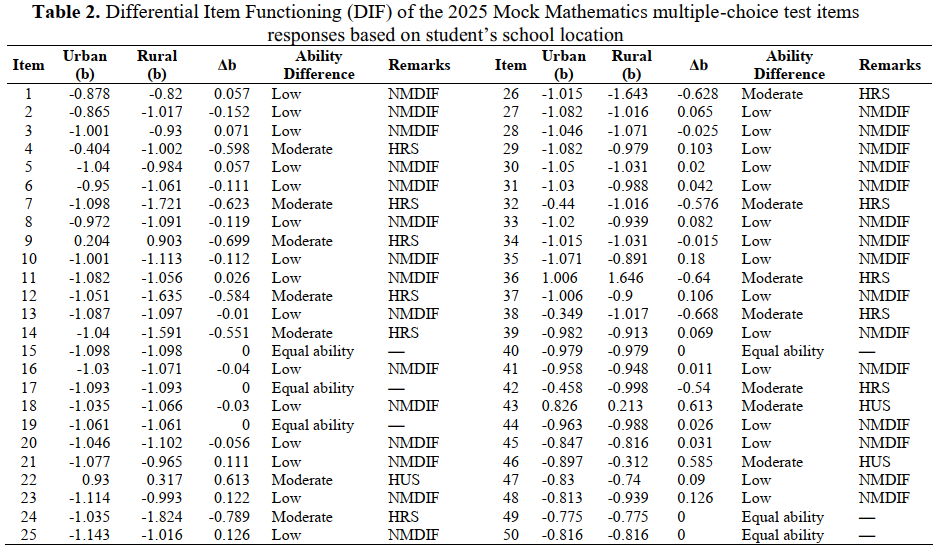
The dearth of test experts in Nigerian’s post-primary schools who have the knowledge and skills to write worthwhile multiple-choice items in different school subjects is a worrisome development to teachers, students, policymakers, government, and society. This development has led to imprecise placement and diagnostic decisions regarding students’ true abilities. This problem prompted this study to assess the model fit and item invariance of 2025 mock mathematics multiple-choice test items in Cross River State, Nigeria. Two research questions were posed for the study. The 2025 mock mathematics multiple-choice item instrument was adapted and administered to a sample of 1015 senior secondary school students drawn from 48 public and private secondary schools in Cross River State. The items were analyzed using Bilog-Mg-3 software to determine chi-square goodness-of-fit and differential item functioning (DIF) using the 1PL, 2PL, and 3PL Item Response Theory (IRT) models. The results revealed that 10 items representing 20% under the 3-parameter logistic models showed significant misfit, indicative of bad items that cannot be trusted for measurement. These items were required to be dropped from the test or revised. The results also revealed that 30 items (60%) had no meaningful DIF, 11 items (12%) were harder for rural students than urban students, and three (3) items (6%) were harder for urban students than rural students, while six (6) items (12%) exhibited no DIF between the two groups of students. It was, therefore, recommended that, among other things, test developers carry out rigorous preliminary testing by administering the items to an illustrative sample before operational use.
References
Anagbogu, G. E., & Owor E. O. (2021). School factors as correlates to examination malpractice among secondary school students in Cross River State, Nigeria. IAR Journal of Humanities and Social Science, 2(4), 1-4. https://doi.org/10.47310/iarjhss.2021.v02i02.005
Anagbogu, G. E., Onu, E., & Owor, E. O. (2021). Evaluation of incidences of examination malpractices and intervention measures among undergraduate students in university of calabar, Nigeria: Implication for assessment and certification. International Journal of Arts and Commerce, 10(8), 16-32
Anagbogu, G. E., Akpan, S.M., & Owor, E. O. (2021). An evaluation of the provision and use of communication facilities in higher educational institutions in Cross River State. IAR Journal of Humanities and Social Science, 2(5), 98-103. https://doi.org/10.47310/IARJHSS.V02I05.014
Anagbogu, G. E., Dada, O.A., Petters, J.S., & Owor, E. O. (2021). An assessment of social media immersions and undergraduate student’s academic performance in research methods in University of Calabar, Nigeria. IAR Journal of Humanities and Social Science, 2(4), 45-53. https://doi.org/10.47310/iarjhss.2021.v02i02.009
Anagbogu, G. E., Ofoegbu, J.U., Ovat, S,V., & Owor, E. O. (2021). A path analytical model on factors with the implementation of civic education curriculum among teachers in Cross River State, Nigeria. International Journal of Education, 9(3), 13-24. https://doi.org/10.5121/IJE2021.9302
Bisong, A. E., Oko, B. A., John, E. I., Achu, R. A., & Owor, E. O. (2021). Personal variables and students' academic performance of virtual Classroom learners of social studies in secondary schools in Uyo Local Government Area, Akwa Ibom State Review of European Studies, 13(3), 11-19. https://doi.org/10.5539/res.v13n3p1
Bond, T. (2015). Applying the Rasch model: Fundamental measurement in the human sciences (3rd ed.). Routledge.
Chen, L., Zhang, S., & Liu, J. (2025). Reducing differential item functioning via process data. https://doi.org/10.48550/arXiv.2504.00136
Dalati, S. (2018). Measurement and measurement scales. Journal of Measurement, 18(7), 79-96
Fährmann, K., Köhler, C., Hartig, J., & Heine, J.-H. (2022). Practical significance of item misfit and its manifestations in constructs assessed in large-scale studies. Large-scale Assessments in Education, 10(1), 7-28. https://doi.org/10.1186/s40536-022-00122-8
Fischer, L. (2021). Consequences of limited item pools and model misfit. Frontiers in Psychology, 12(6), 68-81. https://doi.org/10.3389/fpsyg.2021.633896.
Halpin, P. F. (2022). Differential item functioning via robust scaling. https://doi.org/10.48550/arXiv.2207.04598
Johanns, B., Dinkens, A., & Moore, J. (2107). A systematic review comparing open-book and closed-book examinations: Evaluating effects on development of critical thinking skills. Nurse Education in Practice, 27, 89–94. https://doi.org/10.1016/j.nepr.2017.08.018
Jones, R. N. (2019). Differential item functioning and its relevance to measurement fairness: A review. Journal of Educational Measurement, 56(2), 123–140. https://doi.org/10.1111/jedm.12123.
Köhler, M,, & Hartig , T. (2017). Effects of mindfulness training and nature exposure on psychological well-being. Journal of Environmental Psychology, 12(7), 438-447
Maric, D., et al. (2023). A systematic literature review of psychometric trends in STEM education. International Journal of Education, 9(2), 37-50 https://doi.org/10.1186/s40594-023-00430-x
Mullis, 1. V. S., Martin, M. O., Kennedy, A. M., & Flaherty, C. I. (Eds.) (2010). PIRL 2001 encyclopedia: A reference guide to reading education in the countries participating in IEA’s Progress International Reading Literacy Study (PIRLS). Chestnut Hill, MA: Boston College. TIMSS & PIRLS International Study Center.
Müller, M. (2020). Item fit statistics for Rasch analysis : can we trust them?. Journal of Statistical Distributions and Applications, 7(5). https://doi.org/10.1186/s40488-020-00108-7
Opoku-Asare, N. A. A., & Siaw, A. O. (2015). Rural–urban disparity in students’ academic performance in visual arts education: Evidence from six senior high schools in Kumasi, Ghana. SAGE Open, 5(4), 1–14. https://doi.org/10.1177/2158244015612523
OECD (2022). PISA 2022 Results (Volume I).
Onyibe, C. O., Uma, U. U., & Ibina, E. (2015). Examination malpractice in Nigeria: Causes and effects on National development. Journal of Education and Practice, 6(26), 56-73
Owor, E. O. & Ogba, U. F. (2026). Factors inhibiting goal attainment in public secondary schools in Cross River State, Nigeria: A path analytical model. International Journal of Sub-Saharan African Research, 4(1), 472-484. https://doi:10.5281/zenodo.18957398
Owor, E. O. (2026). A path model of academic performance among part-time students in Nigerian Tertiary institutions: The role of
facilities, peer influence, and teacher-student relationships. Review of European Studies,
(1), 27-41. https://doi.org/10.5539/res.v18n1p41
Ouyang, J., Chen, Y., Li, C., & Xu, G. (2025). Statistical analysis of large-scale item response data under measurement non-invariance. https://doi.org/10.48550/arXiv.2505.16608
Schmucker, R., & Moore, S. (2025). The impact of item-writing flaws on difficulty and discrimination in item response theory. https://doi.org/10.48550/arXiv.2503.105333
Gershenson, S., & Langbein, L. (2015). The Effect of Primary School Size on Academic Achievement. Educational Evaluation and Policy Analysis, 37(1S), 135S-155S. http://www.jstor.org/stable/43773501
Siri, A., & Freddano, M. (2011). The use of item analysis for the improvement of objective examinations. Procedia - Social and Behavioral Sciences, 29, 188–197. https://doi.org/10.1016/j.sbspro.2011.11.224
UNESCO (2020). Global Education Monitoring Report.
UNICEF (2021). The State of the World’s Children.
von Davier, M., & Bezirhan, U. (2023). A robust method for detecting item misfit in large-scale assessments. Educational and Psychological Measurement, 83(4), 740–765. https://doi.org/10.1177/00131644221105819
World Bank (2018). World Development Report: Learning to Realize Education’s Promise. World Bank. http://hdl.handle.net/10986/28340
Zhao, Y., & Hambleton, R. K. (2017). Practical consequences of item response theory model misfit in the context of test equating with mixed-format test data. Frontiers in Psychology, 8(4), 484-499. https://doi.org/10.3389/fpsyg.2017.00484.
Zhao, Y. (2018). The impact of IRT item misfit on score estimates and classification decisions. Quality of Life Research, 26(3), 555–564. https://doi.org/10.1007/s11136-016-1467
Downloads
Published
How to Cite
Issue
Section
License
Copyright (c) 2026 Owor Effiom Owor

This work is licensed under a Creative Commons Attribution-NonCommercial 4.0 International License.