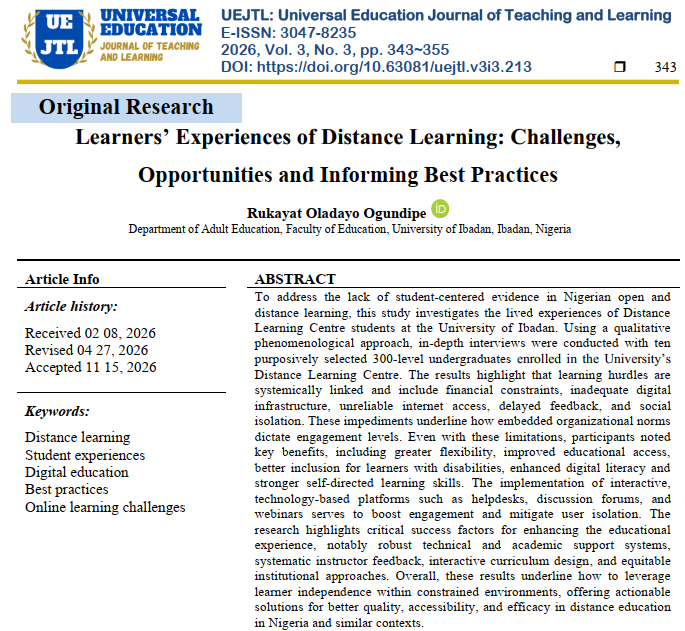
Learners’ Experiences of Distance Learning: Challenges, Opportunities and Informing Best Practices
https://doi.org/10.63081/uejtl.v3i3.213
Distance learning, Student experiences , Digital education , Best practices, Online learning challenges
Abstract
To address the lack of student-centered evidence in Nigerian open and distance learning, this study investigates the lived experiences of Distance Learning Centre students at the University of Ibadan. Using a qualitative phenomenological approach, in-depth interviews were conducted with ten purposively selected 300-level undergraduates enrolled in the University’s Distance Learning Centre. The results highlight that learning hurdles are systemically linked and include financial constraints, inadequate digital infrastructure, unreliable internet access, delayed feedback, and social isolation. These impediments underline how embedded organizational norms dictate engagement levels. Even with these limitations, participants noted key benefits, including greater flexibility, improved educational access, better inclusion for learners with disabilities, enhanced digital literacy and stronger self-directed learning skills. The implementation of interactive, technology-based platforms such as helpdesks, discussion forums, and webinars serves to boost engagement and mitigate user isolation. The research highlights critical success factors for enhancing the educational experience, notably robust technical and academic support systems, systematic instructor feedback, interactive curriculum design, and equitable institutional approaches. Overall, these results underline how to leverage learner independence within constrained environments, offering actionable solutions for better quality, accessibility, and efficacy in distance education in Nigeria and similar contexts.
References
Adamu, A. U. (2022). Status of open and distance learning in Nigeria. Commonwealth of Learning Publications. https://scispace.com/papers/status-of-open-and-distance-learning-in-nigeria-1pf3fmun
Akrofi, O., Gavas, E., & Boateng, E. (2020). Challenges of distance, blended and online learning: A literature-based approach. ResearchGate. https://www.researchgate.net/publication/348281141_Challenges_of_Distance_Blended_and_Online_Learning_A_Literature_based_Approach
Bates, A. W. (2005). Technology, e-learning and distance education. Routledge.
Chaloux, B. (2008). Overcoming the Financial Aid Barrier for E-Learners. Journal of Asynchronous Learning Networks, 12(2), 55-59. https://pdfs.semanticscholar.org/b6d4/b026e4cc450790f15be95395de92d9da47f9.pdf
Christensen, S. S., & Spackman, J. S. (2017). Dropout rates, student momentum and course walls: A new tool for distance education designers. Journal of Educators Online, 14(2), n2. https://files.eric.ed.gov/fulltext/EJ1150708.pdf
Creswell, J. W., & Poth, C. N. (2018). Qualitative Inquiry and Research Design: Choosing Among Five Approaches (4th ed.). SAGE Publications.
Culduz, M. (2024). Benefits and Challenges of E-Learning, Online Education and Distance Learning (pp. 1–27). igi global. https://doi.org/10.4018/979-8-3693-4131-5.ch001
Dille, B., & Mezack, M. (1991). Identifying predictors of high risk among community college telecourse students. American journal of distance education, 5(1), 24-35. https://doi.org/10.1080/08923649109526729
Duman, E. (2023). The challenges of distance education and evidence-based solution suggestions. International Journal of Academic Studies in Technology and Education, 1(1), 50-64. https://pdfs.semanticscholar.org/0640/f82f0a8707a7760f3a5f189371bdf1668ff5.pdf
Edge, W. D., & Loegering, J. P. (2000). Distance Education: Expanding Learning Opportunities. Wildlife Society Bulletin, 28(3), 522-533. https://experts.umn.edu/en/publications/distance-education-expanding-learning-opportunities/
Hara, N. (2000). Student distress in a web-based distance education course. Information, Communication & Society, 3(4), 557-579. https://doi.org/10.1080/13691180010002297?urlappend=%3Futm_source%3Dresearchgate.net%26utm_medium%3Darticle
Itasanmi, S. A., Oni, T. O., & Adelore, O. O. (2020). Students’ assessment of open distance learning programmes and services in Nigeria: A comparative description of three selected distance learning institutions. International Journal of Research and Innovation in Educational Technology (IJORER), 1(3), 64-75. https://doi.org/10.46245/ijorer.v1i3.64
Kanwar, A., & Mishra, S. (2016). Can ODL reach the unreached? Lessons from the Commonwealth. Commonwealth of Learning. https://oasis.col.org/server/api/core/bitstreams/458d4671-bcfb-4814-bf95-d33cb70cff10/content
Karunaratne, K. (2023). Distance Learning: Examining the History, Development And Current State Of Distance Education And Exploring Ways To Improve Access, Equity And Success In Distance Education. Australian Management School. https://www.researchgate.net/publication/367587198_Distance_Learning_Examining_The_History_Development_And_Current_State_Of_Distance_Education_And_Exploring_Ways_To_Improve_Access_Equity_And_Success_In_Distance_Education
Keller, J. M. (2008). An integrative theory of motivation, volition and performance. Technology, Instruction, Cognition and Learning, 6(2), 79-104. http://terrikrause.com/Content/documents/Keller2008IntegrativeTheory.pdf
Kember, D. (2007). Reconsidering Open and Distance Learning in the Developing World (pp. 147-170). Routledge.
Moller, L. (1998). Designing communities of learners for asynchronous distance education. Educational technology research and development, 46(4), 115-122. https://link.springer.com/article/10.1007/BF02299678
Moore, M. G. (1973). Toward a theory of independent learning and teaching. The Journal of Higher Education, 44(9), 661–679. https://doi.org/10.1080/00221546.1973.11776906
Moustakas, C. (1994). Phenomenological Research Methods. SAGE Publications.
National Center for Education Statistics. (2025). Distance and Online Learning in Higher Education. https://www.google.com/url?sa=t&source=web&rct=j&opi=89978449&url=https://nces.ed.gov/fastfacts/display.asp%3Fid%3D80&ved=2ahUKEwjMiK_Nw8mSAxX8QkEAHcAcK38QFnoECBcQAQ&usg=AOvVaw3tD1VOMpomi8g56as7FzNY
NUC. (2025). List of Approved Universities for Distance Learning in Nigeria. https://www.nuc.edu.ng/distance-learning-centers/
Nsiah, G. K. B. (2013). Best Practices in Distance Education: A Review. Creative Education, 4(12), 762-766. https://doi.org/10.4236/ce.2013.412108
Odukoya, J. A., Ayo, C. K., & Azeta, A. (2014). A Review of Open & Distance Education and Human Development in Nigeria. International Journal of Emerging Technologies in Learning (iJET), 9(6), pp. 63–67. https://doi.org/10.3991/ijet.v9i6.4121
Oxford College. (2022). Online Education &E Learning Statistics UK. E-Learning Data. https://www.oxfrodcollege.ac/news/online-education-statistics
Ouko-Ouambo, L. A., Aseey, A., & Kisimbii, J. (2025). Relationship Between Personal Support And Performance Of Students Enrolled In Distance Learning In Selected Public Universities In Kenya And Senegal. African Journal Of Empirical Research Учредители: Ajer Publishin Ouko-Ouambo, L. A., Aseey, A., & Kisimbii, J. (2025). G, 6(1), 281-294. https://Doi.Org/10.51867/Ajernet.6.1.25
Palloff, R. M., & Pratt, K. (2010). Collaborating online: Learning together in community (Vol. 32). John Wiley & Sons.
Pratt, K. (2020). Supporting Distance Learners: Making Practice More Effective. Journal of Open, Flexible and Distance Learning, 24(1), 144-158. https://files.eric.ed.gov/fulltext/EJ1068330.pdf
Rovai, A. P. (2002). Building sense of community at a distance. International Review of Research in Open and Distance Learning, 3(1). https://doi.org/10.19173/irrodl.v3i1.79
Short, J., Williams, E., & Christie, B. (1976). The social psychology of telecommunications. John Wiley & Sons.
Siemens, G. (2005). Connectivism: A learning theory for the digital age. International Journal of Instructional Technology and Distance Learning, 2(1). https://static1.squarespace.com/static/6820668911e3e5617c36c48c/t/682dadc9690ec5749004d96d/1747824073835/connectivism.pdf
Simonson, M. (2009). Best Practices for Distance Education: A Literature Review and a Model for Planning. https://www.researchgate.net/publication/268253228
Stacey, E. (2002). Social presence online: Networking learners at a distance. Educational and Information Technologies, 7(4), 287-289. https://www.qou.edu/ar/sciResearch/pdf/distanceLearning/socialPresence.pdf
Thembane, N. (2024). Navigating the power outages: Impact and coping strategies of students in a South African university during loadshedding. Journal of Student Affairs in Africa, 12(2), 131-142. https://www.google.com/url?sa=t&source=web&rct=j&opi=89978449&url=https://www.ajol.info/index.php/jssa/article/view/295770/278240&ved=2ahUKEwiwu8GNmYuUAxUWaEEAHd4FHwEQFnoECBwQAQ&usg=AOvVaw0OjfxIManJ-Gt6qQiFvoqN
Whipp, J.L., & Lorentz,R. A. (2009). Cognitive and social help giving in online teaching: An exploratory study. Educational Technology Research and Development, 57(2), 169–192. https://doi.org/10.1007/S11423-008-9104-7
Yidana, P., Asapeo, A., & Laar, S. K. (2023). Challenges facing online teaching and learning in african higher education institutions: Empirical review. European Journal of Open Education and E-learning Studies, 8(2). https://oapub.org/edu/index.php/ejoe/article/view/4974
Downloads
Published
How to Cite
Issue
Section
License
Copyright (c) 2026 Rukayat Oladayo Ogundipe

This work is licensed under a Creative Commons Attribution-NonCommercial 4.0 International License.