Investigating the Relationship between AI Literacy and Ethical AI Use among Cambodian Undergraduate Students: The Mediating Role of Perceived AI Ethics
https://doi.org/10.63081/uejtl.v3i3.279
AI Literacy, AI Ethical Use, Perceived AI Ethics, Undergraduate Students
Abstract
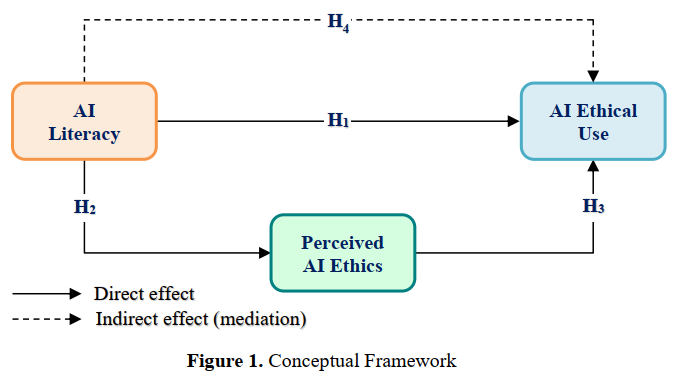
With the growing integration of artificial intelligence (AI) into higher education, promoting students’ ethical AI use has become an important concern. However, empirical evidence on the relationships among AI literacy, perceived AI ethics, and AI ethical use remains limited, particularly in Cambodia. This study examines the relationships among AI literacy, perceived AI ethics, and AI ethical use, including the mediating role of perceived AI ethics. Using a quantitative correlational design, data were collected from 286 undergraduates at four Cambodian universities through convenience sampling and analyzed with SPSS and SmartPLS. AI literacy positively influenced perceived AI ethics (β = 0.732, p < 0.001) and AI ethical use (β = 0.254, p = 0.005), and perceived AI ethics positively affected AI ethical use (β = 0.571, p < 0.001). Perceived AI ethics also partially mediated the relationship between AI literacy and AI ethical use (β = 0.418, p < 0.001). The model explained 53.6% of the variance in perceived AI ethics and 60.3% in AI ethical use. These findings highlight the need to strengthen AI literacy and ethical perceptions, with implications for policymakers, universities, and educators. Future research should validate the model in other contexts.
References
Abayeva, G. A., & Butabayeva, L. A. (2026). Understanding the nature of the relationship between technology use to AI literacy among university students: The mediating role of ethical awareness. Online Journal of Communication and Media Technologies, 16(2), Article 202628. https://doi.org/10.30935/ojcmt/18562
Adamoli, M., Marangi, M., Rondonotti, M., & Raviolo, P. (2025). AI literacy: An explorative analysis of Italian university students’ perceptions of AI skills. Italian Journal of Health Education, Sport and Inclusive Didactics, 9(1), 1–17. https://doi.org/10.32043/gsd.v9i1.1321
Alkaabi, A., Abdallah, A., Alblooshi, S., Alomari, F., & Alneaimi, S. (2025). ChatGPT in higher education: Opportunities, challenges, and required competencies in the absence of guiding policies. Journal of Education and E-Learning Research, 12(2), 153–164. https://doi.org/10.20448/jeelr.v12i2.6746
Al-Kumaim, N. H., Hassan, S. H., Mohammed, F., & Saleh, A. Y. (2025, August). Navigating GenAI in Malaysian universities: Use, problems, and challenges. In Proceedings of the 2025 5th International Conference on Emerging Smart Technologies and Applications (eSmarTA) (pp. 1–7). IEEE. https://doi.org/10.1109/eSmarTA66764.2025.11132252
Alnsour, M. M., Almomani, H., Qouzah, L., Momani, M. Q., Alamoush, R. A., & AL-Omiri, M. K. (2025). Artificial intelligence usage and ethical concerns among Jordanian university students: A cross-sectional study. International Journal for Educational Integrity, 21(1), 1–19. https://doi.org/10.1007/s40979-025-00206-6
Al Shamsi, S., Al Hamami, R., Ali, S., & Elsayary, A. (2025). Impacts of AI usage ethically on students. Journal of Systemics, Cybernetics and Informatics, 23(2), 7–14. https://doi.org/10.54808/JSCI.23.02.7
Anam, M. U., Mahdin, M., Hoque, M. M., Mostofa, A. A., Eftee, S. Y., Islam, A., & Amin, M. A. (2025, November). AI tools in education: Investigating university students’ motivations, institutional policies, and ethical considerations in Bangladesh. In Proceedings of the 37th Australian Conference on Human-Computer Interaction, 974–981. https://doi.org/10.1145/3764687.3769951
Arowosegbe, A., Alqahtani, J. S., & Oyelade, T. (2024). Perception of generative AI use in UK higher education. Frontiers in Education, 9, Article 1463208. https://doi.org/10.3389/feduc.2024.1463208
Atma, R. W. J., Hafizi, M. Z., & Maulida, Z. (2026). Artificial intelligence misuse and digital ethics among university students. Jurnal Pendidikan Sosial Indonesia, 4(1), 47–58. https://doi.org/10.62238/jupsi.v4i1.407
Be, B. (2026). AI in higher education: Attitudes and acceptance among university students in Cambodia. In The future of AI for development (pp. 52–77). Konrad-Adenauer-Stiftung Cambodia. https://www.researchgate.net/publication/400489037_AI_in_Higher_Education_Attitudes_and_Acceptance_Among_University_Students_in_Cambodia
Bewersdorff, A., Hornberger, M., Nerdel, C., & Schiff, D. S. (2025). AI advocates and cautious critics: How AI attitudes, AI interest, use of AI, and AI literacy build university students' AI self-efficacy. Computers and Education: Artificial Intelligence, 8(1), 100340. https://doi.org/10.1016/j.caeai.2024.100340
Chan, C. K. Y. (2023). A comprehensive AI policy education framework for university teaching and learning. International Journal of Educational Technology in Higher Education, 20(1), 1–25. https://doi.org/10.1186/s41239-023-00408-3
Chiu, T. K. F., Ahmad, Z., Ismailov, M., & Sanusi, I. T. (2024). What are artificial intelligence literacy and competency? A comprehensive framework to support them. Computers and Education Open, 6, Article 100171. https://doi.org/10.1016/j.caeo.2024.100171
Davidovitch, N., & Gerkerova, A. (2026). Artificial Intelligence in Higher Education: Benefits and Concerns. African Educational Research Journal, 14(1), 10–20. https://doi.org/10.5281/zenodo.18256386
Deranty, J.-P., & Corbin, T. (2024). Artificial intelligence and work: A critical review of recent research from the social sciences. AI & Society, 39(2), 675–691. https://doi.org/10.1007/s00146-022-01496
Faul, F., Erdfelder, E., Buchner, A., & Lang, A.-G. (2009). Statistical power analyses using G*Power 3.1: Tests for correlation and regression analyses. Behavior Research Methods, 41(4), 1149–1160. https://doi.org/10.3758/BRM.41.4.1149
Febrianti, N., Diandra, A. N., Awalia, A. N., Fadhilatunisa, D., & Fakhri, M. M. (2026). AI awareness, literacy, and social influence predict ethical reasoning and responsible use in higher education. Artificial Intelligence in Lifelong and Life-Course Education, 1(2), 40–52. https://doi.org/10.66053/aillce.v1i2.17
Fernando, Y., & Li, Y. (2025). Responsible AI usage for academic integrity in China. Foresight, 27(6), 1158–1178. https://doi.org/10.1108/FS-05-2024-0095
Fornell, C., & Larcker, D. F. (1981). Evaluating structural equation models with unobservable variables and measurement error. Journal of Marketing Research, 18(1), 39–50. https://doi.org/10.2307/3151312
Gharaibeh, B., Al-Smadi, A. M., & Boyle, D. (2017). Psychometric properties and characteristics of the Diabetes Self-Management Scale. International Journal of Nursing Sciences, 4(3), 252–259. https://doi.org/10.1016/j.ijnss.2017.04.001
Ghosh, M. (2025). Artificial intelligence (AI) and ethical concerns: A review and research agenda. Cogent Business & Management, 12(1), Article 2551809. https://doi.org/10.1080/23311975.2025.2551809
Gliem, J. A., & Gliem, R. R. (2003). Calculating, interpreting, and reporting Cronbach’s alpha reliability coefficient for Likert-type scales. In Proceedings of the 2003 Midwest Research-to-Practice Conference in Adult, Continuing, and Community Education (pp. 82–88). https://www.semanticscholar.org/paper/42147770ce652e700e5623d4611f315addfeee2a
Goreta, G., Wibawa, B., & Siregar, E. (2024). Analysis of artificial intelligence ethics & policy in education. In Proceedings of the 7th International Conference on Learning Innovation and Quality Education (ICLIQE 2023) (pp. 949–961). Atlantis Press. https://doi.org/10.2991/978-2-38476-301-6_92
Hair, J. F., Hult, G. T. M., Ringle, C. M., & Sarstedt, M. (2022). A Primer on Partial Least Squares Structural Equation Modeling (PLS-SEM) (3rd ed.). Sage. https://doi.org/10.1007/978-3-030-80519-7
Hanh, N. V., & Duyen, N. T. (2025). AI-assisted academic cheating: A conceptual model based on postgraduate student voices. Frontiers in Computer Science, 7, 1682190. https://doi.org/10.3389/fcomp.2025.1682190
Henseler, J., Ringle, C. M., & Sarstedt, M. (2015). A new criterion for assessing discriminant validity in variance-based structural equation modeling. Journal of the Academy of Marketing Science, 43(1), 115–135. https://doi.org/10.1007/s11747-014-0403-8
Hoeurng, H., Phorn, P., Kheav, S., & Sam, R. (2024). Integrating artificial intelligence in higher education: A case study of Cambodian universities. European Journal of Theoretical and Applied Sciences, 2(5), 462–473. https://doi.org/10.59324/ejtas.2024.2(5).47
Huot, S., & Loch, S. (2025). Educating in the age of AI: Preparing Cambodian teachers and students for an AI-augmented learning future. Journal of Educational Technology and E-Learning Innovations, 1(2), 31–38. https://doi.org/10.54536/jeteli.v1i2.5170
Huy, S., Chhay, P., Ang, S., Ho, M., & Soeng, P. (2026). AI tool adoption and its impact on perceived learning outcomes among university students in Cambodia. AUB Research Series, 5, 1–27. https://doi.org/10.71215/ars.202651
Jamaluddin, F., & Jamaluddin, A. H. (2025). Malaysia’s AI-driven education landscape: Policies, applications, and comparative insights for a digital future. arXiv. https://doi.org/10.48550/arXiv.2509.21858
Jeilani, A., & Abubakar, S. (2025). Perceived institutional support and its effects on student perceptions of AI learning in higher education: The role of mediating perceived learning outcomes and moderating technology self-efficacy. Frontiers in Education, 10, 1548900. https://doi.org/10.3389/feduc.2025.1548900
Kalniņa, D., Nimante, D., & Baranova, S. (2024). Artificial intelligence for higher education: Benefits and challenges for pre-service teachers. Frontiers in Education, 9, 1501819. https://doi.org/10.3389/feduc.2024.1501819
Kaul, U., & Raghuwanshi, S. (2026, March). Factors influencing students’ intention to adopt Gemini in education. Iconic Research and Engineering Journals, 9(9), 277–283. https://www.irejournals.com/paper-details/1714887
Kelly, R. (2024, August 28). Survey: 86% of students already use AI in their studies. Campus Technology.
Khasawneh, M. A. S. (2024). The incorrect use of artificial intelligence applications among university students and their impact on the credibility of learning. Evolutionary Studies in Imaginative Culture, 8(2, Suppl. 1), 633–644. https://doi.org/10.70082/esiculture.vi.845
Kong, S. C., & Zhu, J. (2025). Developing and validating an artificial intelligence ethical awareness scale for secondary and university students: Cultivating ethical awareness through problem-solving with artificial intelligence tools. Computers and Education: Artificial Intelligence, 9, Article 100447. https://doi.org/10.1016/j.caeai.2025.100447
Koo, M., & Yang, S. W. (2025). Likert-type scale. Encyclopedia, 5(1), 1–11. https://doi.org/10.3390/encyclopedia5010018
Kuleto, V., Ilić, M., Dumangiu, M., Ranković, M., Martins, O. M. D., Păun, D., & Mihoreanu, L. (2021). Exploring opportunities and challenges of artificial intelligence and machine learning in higher education institutions. Sustainability, 13(18), 10424. https://doi.org/10.3390/su13181042
Lan, D. T. H., & Van, D. T. (2025). The challenges of using AI in studying for students at School of Foreign Languages–Thai Nguyen University–Vietnam. International Journal of All Research Writings, 6(9), 142–148. https://ijarw.com/PublishedPaper/IJARW2444.pdf
Limna, P., & Kraiwanit, T. (2024). Assessing the determinants of generative AI integration: A study on Google’s Gemini adoption among Thai university students. Journal of University Teaching and Learning Practice, 21(10), 1–20. https://doi.org/10.53761/7zmssq60
Long, D. Y., Wang, S., Rashid, S. M., & Lu, X. T. (2026). Artificial intelligence in higher education: A systematic review of its impact on student engagement and the mediating role of teaching methods. Frontiers in Education, 10, 1648661. https://doi.org/10.3389/feduc.2025.1648661
Mat Yusoff, S., Mohamad Marzaini, A. F., Hao, L., Zainuddin, Z., & Basal, M. H. (2025). Understanding the role of AI in Malaysian higher education curricula: An analysis of student perceptions. Discover Computing, 28(1), Article 62. https://doi.org/10.1007/s10791-025-09567-5
Meneses III, J. M. (2026). AI literacy and ethical awareness: A study on educators’ preparedness for responsible AI use. Indian Journal of Science and Technology, 19(17), 1093–1100. https://doi.org/10.17485/IJST/v19i17.523
Nurhaliza, N. (2025). AI literacy and ethical awareness in higher education: Evidence from Indonesian universities. International Journal of Social Research, 3(4), 190–202. https://doi.org/10.59888/insight.v3i4.60
O’Dea, X., Bale, R., Chiu, Y.-L. T., Suleymenova, K., Tinker, A., & Stoker, R. (2025). Ethical uses of generative AI in assessment: Student perceptions in UK contexts. Evaluation Review. Advance online publication.
https://doi.org/10.1177/0193841X251399712
Osang, O. G., Idiong, S. P., & Akanimoh, M. E. (2025). Unethical issues in the use of artificial intelligence (AI) among undergraduates in public universities of Cross River State, Nigeria. Journal of Humanities and Social Policy, 11(5), 136–146. https://doi.org/10.56201/jhsp.vol.11.no5.2025.pg136.146
Osasona, F., Amoo, O. O., Atadoga, A., Abrahams, T. O., Farayola, O. A., & Ayinla, B. S. (2024). Reviewing the ethical implications of AI in decision-making processes. International Journal of Management & Entrepreneurship Research, 6(2), 322–335. https://doi.org/10.51594/ijmer.v6i2.773
Pramod, D. (2025). Decoding responsible AI use: The influence of digital literacy and ethical awareness. Cogent Education, 12(1), 1–14. https://doi.org/10.1080/2331186X.2025.2592371
Promma, W., Imjai, N., Usman, B., & Aujirapongpan, S. (2025). The influence of AI literacy on complex problem-solving skills through systematic thinking skills and intuition thinking skills: An empirical study in Thai Gen Z accounting students. Computers and Education: Artificial Intelligence, 8(12), 100382. https://doi.org/10.1016/j.caeai.2025.100382
Pum, M., & Sok, S. (2024). Leveraging AI in education in Cambodia: A review of perceived concerns and associated benefits. Asian Journal of Distance Education, 19(2), 157–167. https://asianjde.com/ojs/index.php/AsianJDE/article/view/794
Rahiman, H. U., & Kodikal, R. (2024). Revolutionizing education: Artificial intelligence empowered learning in higher education. Cogent Education, 11(1), 2293431. https://doi.org/10.1080/2331186X.2023.2293431
Rangavittal, P. B. (2024). Transforming higher education with artificial intelligence: Benefits, challenges, and future directions. International Journal of Science and Research (IJSR), 13(5), 1635–1642. https://doi.org/10.53469/jrve.2024.06(08).13
Robert, A., Potter, K., & Frank, L. (2024). The impact of artificial intelligence on students' learning experience. Wiley Interdisciplinary Reviews: Computational Statistics, 2(1), 75–84. https://doi.org/10.2139/ssrn.4716747
Rožman, M., Oreški, D., Elias, A. A., Pynadath, M. F., & Tominc, P. (2025). AI literacy among university students: A comparative study of three countries—Slovenia, Croatia, and India. IEEE Access, 13(99), 110671–110688. https://doi.org/10.1109/ACCESS.2025.3581128
Saputra, G. M., Tambunan, E. W., Dwiani, A. N., Jannah, D. M., & Mohammed, S. (2026). Ethical awareness, perceived usefulness, and AI literacy predict university students’ intentions to use AI tools. Artificial Intelligence in Lifelong and Life-Course Education, 1(2), 27–39. https://journal.abcollab.id/index.php/AILLCE/article/view/16
Saxena, M. K., & Bajotra, V. (2024). Potential of artificial intelligence in education and ethical issues. Far Western Journal of Education, 1(1), 1–18. https://doi.org/10.3126/fwje.v1i1.68773
Shaengchart, Y., Bhumpenpein, N., & Limna, P. (2025). Determinants of Google’s Gemini AI chatbot adoption among higher education students in Bangkok, Thailand. Buriram Rajabhat University Journal of Interdisciplinary Management, 9(1), 38–52. https://so02.tci-thaijo.org/index.php/journalfms-thaijo/article/view/271875
Slimi, Z., Benayoune, A., & Alemu, A. E. (2025). Students' perceptions of artificial intelligence integration in higher education. European Journal of Educational Research, 14(2), 471–484. https://doi.org/10.12973/eu-jer.14.2.471
Sloane, M., & Zakrzewski, J. (2022, June). German AI start-ups and “AI ethics”: Using a social practice lens for assessing and implementing socio-technical innovation. In Proceedings of the 2022 ACM Conference on Fairness, Accountability, and Transparency (FAccT ’22) (pp. 935–947). ACM. https://doi.org/10.1145/3531146
Sok, S., & Heng, K. (2024). Generative AI in higher education: The need to develop or revise academic integrity policies to ensure the ethical use of AI in Cambodia. International Journal of Education and Research, 6(1), 1–8. https://doi.org/10.2139/ssrn.4806030
Sol, K., Heng, K., & Sok, S. (2024). Using AI in English language education: An exploration of Cambodian EFL university students’ experiences, perceptions, and attitudes (pp. 1–36). SSRN. https://doi.org/10.2139/ssrn.4687461
Sun, Y., Li, L., Zhang, X., Chen, X., Deng, S., & Hu, X. (2026). AI literacy and psychosocial factors shaping Chinese university students’ attitudes and behavioral intentions toward generative AI use. BMC Psychology, 14(1), 1–16. https://doi.org/10.1186/s40359-026-03989-6
Tao, N. (2026). Exploring Cambodian EFL university students’ AI literacy and experiences: A qualitative analysis. Cambodian Journal of Educational Research, 6(1), 1–28. https://doi.org/10.62037/cjer.2026.06.01.03
Tick, A., Toktosunova, A., Fallah, H., Toutouchi, Z., & Tadzhibaeva, Z. (2023). The impact of ChatGPT on learning in higher education: Results of a pilot study. Practice and Theory in Systems of Education, 18(1), 31–50. https://doi.org/10.63145/ptse.v18i1.6
Toker Gökçe, A., Deveci Topal, A., Kolburan Geçer, A., & Dilek Eren, C. (2025). Investigating the level of artificial intelligence literacy of university students using decision trees. Education and Information Technologies, 30(5), 6765–6784. https://doi.org/10.1007/s10639-024-13081-4
Tran, Q. G., & Truong, T. D. (2026). Artificial intelligence in Vietnamese higher education: Impacts on the innovation of teaching methods and learners’ learning experiences. Journal of Education and E-Learning Research, 13(2), 54–65. https://doi.org/10.20448/jeelr.v13i2.8564
Vieriu, A. M., & Petrea, G. (2025). The impact of artificial intelligence (AI) on students’ academic development. Education Sciences, 15(3), Article 343. https://doi.org/10.3390/educsci15030343
Villaceran, E. C., & Himang, C. M. (2025). Data on behavioural intention to use AI copilot through TAM and AI ecological education policy lens. Data in Brief, 61(1), 111686. https://doi.org/10.1016/j.dib.2025.111686
Xie, X., Gu, K., & Wang, X. (2025). The impact of technology ethics governance on the development of corporate artificial intelligence: A quasi-natural experiment based on technology ethics review. Finance Research Letters, 86, Article 108357. https://doi.org/10.1016/j.frl.2025.108357
Xue, Y., Chinapah, V., & Zhu, C. (2025). A comparative analysis of AI privacy concerns in higher education: News coverage in China and Western countries. Education Sciences, 15(6), 1–25. https://doi.org/10.3390/educsci15060650
Yan, Y., Wu, B., Pi, J., & Zhang, X. (2025). Perceptions of AI in higher education: Insights from students at a top-tier Chinese university. Education Sciences, 15(6), 735. https://doi.org/10.3390/educsci15060735
Younas, M., Shoukat, A., & Mahmood, T. (2024). Students’ awareness and perception regarding the usage of AI in education at Government College University, Faisalabad. Journal of Social Sciences Advancement, 5(4), 80–85. https://doi.org/10.52223/JSSA24-050410-106
Yu, C., Yan, J., & Cai, N. (2024). ChatGPT in higher education: Factors influencing ChatGPT user satisfaction and continued use intention. Frontiers in Education, 9, 1354929. https://doi.org/10.3389/feduc.2024.1354929
Downloads
Published
How to Cite
Issue
Section
License
Copyright (c) 2026 Chhayna Cheng

This work is licensed under a Creative Commons Attribution-NonCommercial 4.0 International License.