Comparative Study of Students' Motivation in Learning Biology between Private Schools in Urban and Rural Areas
https://doi.org/10.63081/uejtl.v1i4.71
Comparative study, Motivation, Learning biology, Urban and rural areas
Abstract
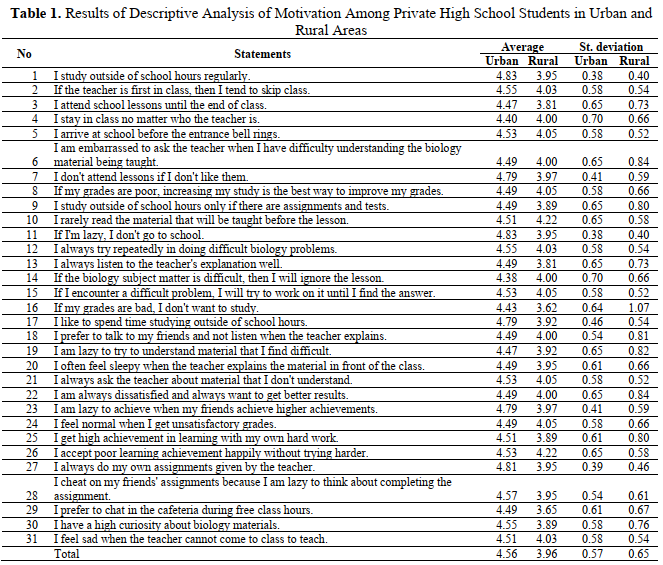
This study compares students' motivation to study Biology between private schools in urban and rural areas. A quantitative approach with a comparative design was used in this study, involving 47 private high school students in Malang City as a representation of the urban areas and 37 private high school students in Malang Regency as a representation of rural areas. The research instrument was a closed questionnaire consisting of 31 statements reflecting the five dimensions of learning motivation: perseverance, tenacity, interest, achievement, and independence. Data were analyzed using descriptive statistics to see an overview of student motivation and the Mann-Whitney U test to test for significant differences between the two groups. The descriptive analysis results showed that students' mean motivation in urban areas was higher (4.56) than in rural areas (3.96). The standard deviation of urban students (0.57) was lower than that of rural students (0.65), indicating a smaller score variation. The Mann-Whitney U test showed a significant difference in motivation between the two groups. The results of this study confirm that students' learning motivation in urban private schools is higher compared to students in rural areas, which differences may influence educational facilities, access to learning resources, and environmental support. The findings are expected to serve as a basis for policymakers to design interventions to reduce the learning motivation gap between urban and rural areas.
References
Amin, M. T., & Harahap, R. D. (2023). Analysis of students learning interest in biology subject matter of viruses in grade X senior high school. BIO-INOVED: Jurnal Biologi-Inovasi Pendidikan, 5(2), 179-186. https://dx.doi.org/10.20527/bino.v5i2.15549
Blackmore, J., Hobbs, L., & Rowlands, J. (2024). Aspiring teachers, financial incentives, and principals’ recruitment practices in hard-to-staff schools. Journal of Education Policy, 39(2), 233-252. https://doi.org/10.1080/02680939.2023.2193170
Burke, P. F., & Buchanan, J. (2022). What attracts teachers to rural and remote schools? Incentivising teachers’ employment choices in New South Wales. Australian Journal of Education, 66(2), 115-139. https://doi.org/10.1177/00049441211066357
Cartono, C. (2022). The importance of environmental education in biology learning to increase students' environmental awareness. Jurnal Info Sains: Informatika dan Sains, 12(2), 91-97. Retrieved from https://ejournal.seaninstitute.or.id/index.php/InfoSains/article/view/3516
Chen, L., & Tian, F. F. (2023). Rural-urban gap and career preparation trajectories in a Chinese elite university. International Studies in Sociology of Education, 32(4), 924-949. https://doi.org/10.1080/09620214.2021.1948893
Elacqua, G., Hincapie, D., Hincapié, I., & Montalva, V. (2022). Can financial incentives help disadvantaged schools to attract and retain high‐performing teachers? Evidence from Chile. Journal of Policy Analysis and Management, 41(2), 603-631. https://doi.org/10.1002/pam.22375
Evans, D. K., & Acosta, A. M. (2023). How to recruit teachers for hard-to-staff schools: A systematic review of evidence from low-and middle-income countries. Economics of Education Review, 95, 102430. https://doi.org/10.1016/j.econedurev.2023.102430
Fauzi, A., Rosyida, A. M., Rohma, M., & Khoiroh, D. (2021). The difficulty index of biology topics in Indonesian Senior High School: Biology undergraduate students’ perspectives. JPBI (Jurnal Pendidikan Biologi Indonesia, 7(2), 149-158. https://doi.org/10.22219/jpbi.v7i2.16538
Gao, C. Y., Dollinger, M., D'Angelo, B., & Harvey, A. (2022). Leveraging local knowledge: Exploring how to support regional, rural and remote students' career development. Australian and International Journal of Rural Education, 32(1), 1-17. https://search.informit.org/doi/10.3316/informit.395181019851482
Hadiprayitno, G., Muhlis, & Kusmiyati. (2019). Problems in learning biology for senior high schools in Lombok Island. Journal of Physics: Conference Series, 1241(1), 012054. IOP Publishing. https://doi.org/10.1088/1742-6596/1241/1/012054
Hardré, P. L., & Sullivan, D. W. (2008). Student differences and environment perceptions: How they contribute to student motivation in rural high schools. Learning and Individual Differences, 18(4), 471-485. https://doi.org/10.1016/j.lindif.2007.11.010
Hogan, D., & O’Flaherty, J. (2021). Addressing education for sustainable development in the teaching of science: The case of a biological sciences teacher education program. Sustainability, 13(21), 12028. https://doi.org/10.3390/su132112028
Juneja, N. (2021). Education in urban areas. In The Routledge Handbook of Education in India (pp. 26-41). Routledge.
Kumah-Abiwu, F. (2022). Urban education and academic success: The case of higher achieving Black males. Urban Education, 57(9), 1565-1591. https://doi.org/10.1177/0042085919835284
Littledyke, M. (2008). Science education for environmental awareness: Approaches to integrating cognitive and affective domains. Environmental Education Research, 14(1), 1-17. https://doi.org/10.1080/13504620701843301
Rachmatullah, A., Roshayanti, F., Shin, S., Lee, J. K., & Ha, M. (2018). The secondary-student science learning motivation in Korea and Indonesia. EURASIA Journal of Mathematics, Science and Technology Education, 14(7), 3123-3141. https://doi.org/10.29333/ejmste/91665
Rahmi, N. A., Sumarmin, R., Ahda, Y., Alberida, H., & Razak, A. (2021). Relationship between learning motivation and biology learning outcomes. Jurnal Penelitian Pendidikan IPA, 7(4), 537-541. https://doi.org/10.29303/jppipa.v7i4.773
Ryan, R. M., & Deci, E. L. (2020). Intrinsic and extrinsic motivation from a self-determination theory perspective: Definitions, theory, practices, and future directions. Contemporary Educational Psychology, 61, 101860. https://doi.org/10.1016/j.cedpsych.2020.101860
Saka, A. O., & Onanuga, P. A. (2022). Achievement motivation and students’ achievement in secondary biology: Is the relationship mediated by cognitive style? Sakarya University Journal of Education, 12(1), 58-76. https://doi.org/10.19126/suje.980052
Salim, R. M. A., Istiasih, M. R., Rumalutur, N. A., & Situmorang, D. D. B. (2023). The role of career decision self-efficacy as a mediator of peer support on students’ career adaptability. Heliyon, 9(4). https://doi.org/10.1016/j.heliyon.2023.e14911
Starrett, A., Irvin, M. J., Lotter, C., & Yow, J. A. (2022). Understanding the relationship of science and mathematics place-based workforce development on adolescents’ motivation and rural aspirations. American Educational Research Journal, 59(6), 1090-1121. https://doi.org/10.3102/00028312221099009
Sun, P., Wang, L., & Yan, L. (2025). Mediation of coping style between academic self-efficacy and academic stress in middle school students. Frontiers in Psychology, 16, 1496528. https://doi.org/10.3389/fpsyg.2025.1496528
Tayyaba, S. (2012). Rural-urban gaps in academic achievement, schooling conditions, student, and teachers' characteristics in Pakistan. International Journal of Educational Management, 26(1), 6-26. https://doi.org/10.1108/09513541211194356
Weelie, D. V., & Wals, A. (2002). Making biodiversity meaningful through environmental education. International Journal of Science Education, 24(11), 1143-1156. Retrieved from https://www.researchgate.net/publication/40129881_Making_biodiversity_meaningful_through_environmental_education
Yong, B. C. S. (2009). Students’ motivational orientations and their association with achievement in biology. Brunei International Journal of Science & Math Education, 1(2), 56-64. Retrieved from https://shbieejournal.wordpress.com/wp-content/uploads/2009/11/science093forrevisedfinalbobeditedpdf.pdf
Zhang, H., Couch, S., Estabrooks, L., Perry, A., & Kalainoff, M. (2023). Role models’ influence on student interest in and awareness of career opportunities in life sciences. International Journal of Science Education, Part B, 13(4), 381-399. https://doi.org/10.1080/21548455.2023.2180333
Zhao, K. (2022). Rural-urban gap in academic performance at a highly selective Chinese university: variations and determinants. Higher Education Research & Development, 41(1), 177-192. https://doi.org/10.1080/07294360.2020.1835836
Zhou, M. (2003). Urban education: Challenges in educating culturally diverse children. Teachers College Record, 105(2), 208-225. https://doi.org/10.1177/016146810310500207
Downloads
Published
How to Cite
Issue
Section
License
Copyright (c) 2026 Nova Riama Lumban Raja, Tjatur Imbang Sasono

This work is licensed under a Creative Commons Attribution-NonCommercial 4.0 International License.