Autonomous Learning in Higher Education: An Iraqi EFL Students’ Perceptions
https://doi.org/10.63081/uejtl.v1i4.87
Autonomous learning, Higher education, English as a foreign language, Students’ perceptions
Abstract
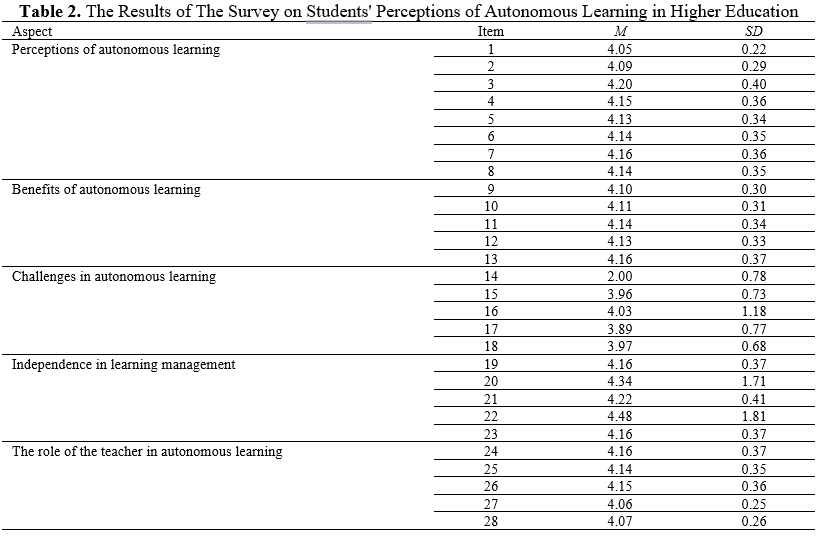
This study investigates the perceptions of Iraqi EFL (English as a Foreign Language) students regarding autonomous learning (AL) and its impact on their academic development. With the increasing importance of English for communication, education, and career prospects in a globalized world, understanding students' views on AL is critical, especially in Iraq, where traditional, teacher-centered pedagogies dominate. The research employs a survey method, gathering data from 359 EFL students across six universities in Iraq. The questionnaire addresses various aspects of AL, including perceptions, benefits, challenges, independence in learning management, and the role of the teacher. The findings indicate that Iraqi students generally view AL positively, with high scores for motivation, goal-setting, and critical thinking, underscoring the value of learner autonomy. Benefits such as improved problem-solving skills and deeper engagement with course material were frequently mentioned. However, challenges such as difficulty in self-motivation and the lack of social support were also highlighted. Additionally, students expressed a desire for more structured teacher involvement in guiding their autonomous learning efforts. This study concludes that while AL significantly enhances student independence and learning outcomes, the success of AL initiatives in Iraqi higher education depends on providing sufficient support, motivation, and resources for students. The research also emphasizes the need for teachers to play a facilitative role in the AL process. The findings contribute valuable insights into how AL can be adapted to meet the specific needs and challenges of Iraqi EFL learners, offering a foundation for future educational reforms in the region.
References
Abdulhameed, D. Q., & Louber, I. (2024). EFL teachers’ perceptions of learner-centered teaching in public schools of the kurdistan region of iraq. Twejer, 7(3), 1513–1553. https://doi.org/10.31918/twejer.2473.55
Abdulhassan, M., Hussein, A., & Abdul-Settar, R. (2024). The investigation of grammar learning strategies among Iraqi EFL learners. Journal of Teaching English for Specific and Academic Purposes, 677-691. https://espeap.junis.ni.ac.rs/index.php/espeap/article/view/1512
Abualhaija, N. (2019). Using constructivism and student-centered learning approaches in nursing education. International Journal of Nursing and Health Care Research, 5(7). https://doi.org/10.29011/IJNHR-093.100093
Ahmad, S., & Ahmad, N. (2015). Fostering inter-cultural communication skills among learners through teaching English as an international language. International Journal of Applied Linguistics and English Literature, 4(6), 52–57. https://doi.org/10.7575/aiac.ijalel.v.4n.6p.52
Aldosari, M. S., & Alsager, H. N. (2023). A step toward autonomy in education: probing into the effects of practicing self-assessment, resilience, and creativity in task supported language learning. BMC psychology, 11(1), 434. https://doi.org/10.1186/s40359-023-01478-8
Ali, F., Choy, D., Divaharan, S., Tay, H. Y., & Chen, W. (2023). Supporting self-directed learning and self-assessment using TeacherGAIA, a generative AI chatbot application: Learning approaches and prompt engineering. Learning: research and practice, 9(2), 135-147. https://doi.org/10.1080/23735082.2023.2258886
Alqahtani, R. M., & Alhamami, M. (2024). English as a foreign language teaching approaches in Saudi K–12 education: teacher-centered or student-centered. Journal of Education and Learning, 18(3), 817–824. https://doi.org/10.11591/edulearn.v18i3.21303
Boulkrooun, F. (2020). Adapting piagetian concepts to L2 learning: Pedagogical implications. Revue Sciences Humaines, 31(2), 1041–1050.
Chalupa, C., & ter Haseborg, H. (2014). Improving student motivation through autonomous learning choices. The Northeast Conference on the Teaching of Foreign Languages, 74, 53–85. http://www.nectfl.org/sites/g/files/g784796/f/201408/NECTFL_74_Final.pdf
Chen, A., Wei, Y., Le, H., & Zhang, Y. (2026). Learning by teaching with ChatGPT: The effect of teachable ChatGPT agent on programming education. British Journal of Educational Technology, 57(1), 163-184. https://doi.org/10.1111/bjet.70001
Lin, X. (2024). Exploring the role of ChatGPT as a facilitator for motivating self-directed learning among adult learners. Adult Learning, 35(3), 156-166. https://doi.org/10.1177/10451595231184928
Liu, W., & Wang, Y. (2024). The effects of using AI tools on critical thinking in English literature classes among EFL learners: An intervention study. European Journal of Education, 59(4), e12804. https://doi.org/10.1111/ejed.12804
Mahmood, A. M., & Mohammadzadeh, B. (2022). The effectiveness of ICT-supported flipped learning in an EFL context: A case of northern Iraq. Frontiers in Psychology, 13, 943956. https://doi.org/10.3389/fpsyg.2022.943956
Macaskill, A., & Denovan, A. (2013). Developing autonomous learning in first year university students using perspectives from positive psychology. Studies in Higher Education, 38(1), 124–142. https://doi.org/10.1080/03075079.2011.566325
Mohammed, A. F. (2018). Language and culture: Contexts in british english and iraqi arabic. RUDN Journal of Language Studies, Semiotics and Semantics, 9(3), 761–773. https://doi.org/10.22363/2313-2299-2018-9-3-761-773
Ng, D. T. K., Tan, C. W., & Leung, J. K. L. (2024). Empowering student self‐regulated learning and science education through ChatGPT: A pioneering pilot study. British Journal of Educational Technology, 55(4), 1328-1353. https://doi.org/10.1111/bjet.13454
Pan, Y., & Gauvain, M. (2012). The continuity of college students’ autonomous learning motivation and its predictors: A three-year longitudinal study. Learning and Individual Differences, 22(1), 92–99. https://doi.org/10.1016/j.lindif.2011.11.010
Ponomariovienė, J., & Jakavonytė-Staškuvienė, D. (2024). Solutions for independent goal setting and implementation of primary school students fostering the competence of learning to learn. Education sciences, 14(4), 368. https://doi.org/10.3390/educsci14040368
Sadiq, D. A. (2022). The effects of blended learning on students’ achievement in a foundation english course: A study on foundation english students at TISHK University in Erbil, Iraq. Revista Amazonia Investiga, 11(59), 21-34. https://dialnet.unirioja.es/servlet/articulo?codigo=8813594
Siziba, T., Geduld, B., & Du Toit-Brits, C. (2025). Empowering learners: exploring teacher perceptions in motivating and fostering self-directed learning skills. Cogent Education, 12(1), 2548351. https://doi.org/10.1080/2331186X.2025.2548351
Starke-Meyerring, Doreen. (2005). Meeting the challenges of globalization: A framework for global literacies in professional Communication Programs. Journal of Business and Technical Communication, 19(4), 468–499. https://doi.org/10.1177/1050651905278033
Stefanou, Candice, Stolk, Jonathan D, Prince, Michael, Chen, John C, & Lord, Susan M. (2013). Self-regulation and autonomy in problem- and project-based learning environments. Active Learning in Higher Education, 14(2), 109–122. https://doi.org/10.1177/1469787413481132
Wang, X., Yang, L., Chen, K., & Zheng, Y. (2024). Understanding teacher emotional exhaustion: exploring the role of teaching motivation, perceived autonomy, and teacher–student relationships. Frontiers in psychology, 14, 1342598. https://doi.org/10.3389/fpsyg.2023.1342598
Wendimu, S. G., & Gebremariam, H. T. (2024). Teacher-students collaboration: Using guided-writing instruction to assist learners with writing difficulties and low motivation to write. Sage Open, 14(2), 21582440241258020. https://doi.org/10.1177/21582440241258020
Wertsch, J. V. (1984). The zone of proximal development: Some conceptual issues. New Directions for Child and Adolescent Development, 23, 7–18. https://doi.org/10.1002/cd.23219842303
Wong, F. M., & Kan, C. W. (2022). Online problem-based learning intervention on self-directed learning and problem-solving through group work: A waitlist controlled trial. International journal of environmental research and public health, 19(2), 720. https://doi.org/10.3390/ijerph19020720
Yu, H. (2024). The application and challenges of ChatGPT in educational transformation: New demands for teachers' roles. Heliyon, 10(2). https://doi.org/10.1016/j.heliyon.2024.e24289
Yurdakul, C. (2017). An investigation of the relationship between autonomous learning and lifelong learning. International Journal of Educational Research Review, 2(1), 15–20. https://doi.org/10.24331/ijere.309968
Zhang, H. (2024). The impact of english language development on internationalization of education. Lecture Notes in Education Psychology and Public Media, 34(1), 243–249. https://doi.org/10.54254/2753-7048/34/20231933
Downloads
Published
How to Cite
Issue
Section
License
Copyright (c) 2024 Mohammad Hossein Ranjbar, Sara Fatemeh Nasiri

This work is licensed under a Creative Commons Attribution-NonCommercial 4.0 International License.