Bibliometric Analysis of Language Learning in Elementary Schools: Trends and Future Research Directions
https://doi.org/10.63081/uejtl.v1i4.90
Language learning, Elementary schools, Bibliometric analysis
Abstract
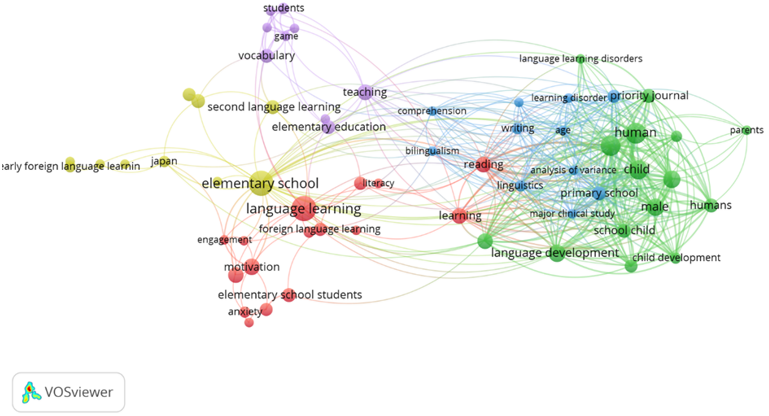
Language learning in elementary schools is fundamental for children’s literacy and communication development, yet no bibliometric study has comprehensively mapped this field. This study fills that gap by conducting a bibliometric analysis using the Scopus database with the keywords “language learning” AND “elementary school,” yielding 355 documents, of which 204 articles published between 2004 and 2024 were analyzed following PRISMA procedures. Data were processed using Bibliometrix (R) and VOSviewer to examine publication trends, citations, and keyword networks. The results show a significant rise in publications since 2015, driven by global agendas such as SDG 4, the expansion of digital and mobile learning, and national policies emphasizing literacy. Keyword mapping revealed three dominant clusters: language learning and development linked to motivation and anxiety; child development and primary education, highlighting the role of developmental psychology; and language learning disorders, linguistics, and writing, underscoring inclusivity and technical aspects. Recent trends further indicate growing interest in vocabulary acquisition, technology-based pedagogy, and problem-solving approaches. This study offers novelty as the first bibliometric mapping of language learning in elementary schools, providing a holistic overview of research growth, thematic focus, and directions for future inquiry in digital pedagogy, inclusivity, and international collaboration.
References
Alam, M. I., Mansur, M., & Barman, P. (2022). Early childhood development in Bangladesh and its socio-demographic determinants of importance. Early Child Development and Care, 192(12), 1901–1920. https://doi.org/10.1080/03004430.2021.1951260
Azizah, N. L., Mustofa, A., & Retnaningdyah, P. (2025). Sustainable development in english language teaching: Prevailing trends, challenges, and outcomes. Education and Human Development Journal, 10(1), 1–16. https://doi.org/10.33086/ehdj.v10i1.6763
Baas, J., Schotten, M., Plume, A., Côté, G., & Karimi, R. (2020). Scopus as a curated, high-quality bibliometric data source for academic research in quantitative science studies. Quantitative Science Studies, 1(1), 377–386. https://doi.org/10.1162/qss_a_00019
Binod, M. (2015). Innovative ways of English language teaching in rural India through Technology. International Journal of English and Literature, 6(2), 38–44. https://doi.org/10.5897/ijel2014.0686
Chowdhury, R., & Kabir, A. H. (2014). Language wars: English education policy and practice in Bangladesh. Multilingual Education, 4(1), 1–16. https://doi.org/10.1186/s13616-014-0021-2
Chun, D., Kern, R., & Smith, B. (2016). Technology in language use, language teaching, and language learning. The Modern Language Journal, 100(S1), 64–80. https://doi.org/10.1111/modl.12302
da Silva, F. F., Filser, L. D., Juliani, F., & de Oliveira, O. J. (2018). Where to direct research in lean six sigma? International Journal of Lean Six Sigma, 9(3), 324–350. https://doi.org/10.1108/IJLSS-05-2017-0052
Duarte, D. (2012). Universidade de Aveiro Departamento de Química. 1–42.
Farida, N., & Chowdhury, N. M. (2025). Curriculum Reformation by Implementing the Sustainable Development Goals (SDGs): The Case of dhaka university english department. International Journal of Educational Reform. https://doi.org/10.1177/10567879251363199
Gharaibeh, M., & Alhassan, A. A. (2023). Role of teachers in teaching Arabic letters to young children of UAE: Exploring criteria of Arabic letters teaching. Cogent Education, 10(1). https://doi.org/10.1080/2331186X.2023.2191392
Ghazi, S. R., & Ullah, K. (2015). Concrete Operational stage of piaget’s cognitive development theory: An implication in learning general science. Gomal University Journal of Research, 31(1), 78–89. https://doi.org/http://gujr.com.pk/index.php/GUJR/article/view/326
Gouvias, D., & Alexopoulos, C. (2018). Sexist stereotypes in the language textbooks of the Greek primary school: a multidimensional approach. Gender and Education, 30(5), 642–662. https://doi.org/10.1080/09540253.2016.1237620
Hajar, A., & Karakus, M. (2025). Five decades of language learning strategy research: a bibliometric review and research agenda. The Language Learning Journal, 53(2), 220–249. https://doi.org/10.1080/09571736.2024.2361145
Hassan, W., & Duarte, A. E. (2024). Bibliometric analysis: A few suggestions. Current Problems in Cardiology, 49(8), 102640. https://doi.org/10.1016/j.cpcardiol.2024.102640
Hossain, S. J., Hamadani, J. D., Tofail, F., Fisher, J., Rahman, M. A., & Rahman, S. M. (2024). Factors associated with children’s cognitive, language, and motor development in deprived urban settings in Bangladesh. Child: Care, Health and Development, 50(1), 1–12. https://doi.org/10.1111/cch.13225
Karakaya, K., & Bozkurt, A. (2022). Mobile-assisted language learning (MALL) research trends and patterns through bibliometric analysis: Empowering language learners through ubiquitous educational technologies. System, 110(September), 102925. https://doi.org/10.1016/j.system.2022.102925
Klarin, A. (2024). How to conduct a bibliometric content analysis: Guidelines and contributions of content co-occurrence or co-word literature reviews. International Journal of Consumer Studies, 48(2), 1–20. https://doi.org/10.1111/ijcs.13031
Kleminski, Rajmund, Kazienko, Przemysiaw, & Kajdanowicz, Tomasz. (2020). Analysis of direct citation, co-citation and bibliographic coupling in scientific topic identification. Journal of Information Science, 48(3), 349–373. https://doi.org/10.1177/0165551520962775
Kostas, M. (2021). Discursive construction of hegemonic masculinity and emphasised femininity in the textbooks of primary education: children’s discursive agency and polysemy of the narratives. Gender and Education, 33(1), 50–67. https://doi.org/10.1080/09540253.2019.1632807
Lai, C., Shum, M., & Tian, Y. (2016). Enhancing learners’ self-directed use of technology for language learning: the effectiveness of an online training platform. Computer Assisted Language Learning, 29(1), 40–60. https://doi.org/10.1080/09588221.2014.889714
Luthfiyah, I. (2025). Literature Review Trends and Directions in Online Learning Research in Physics and Astronomy Education : A Bibliometric Analysis. UEJTL: Universal Education Journal of Teaching and Learning, 2(1), 10–22. https://doi.org/10.63081/uejtl.v2i1.41
Maflah Alharbi, J. (2023). Insight into the Role of interaction in language acquisition: Vygotsky’s interactionist theory of language. Arab World English Journal, 14(2), 281–294. https://doi.org/10.24093/awej/vol14no2.20
Magno, J. M., Indal, R. S., Chavez, J. V., Garil, B. A., & Delos Reyes, R. B. (2024). Alternative teaching strategies in learning filipino language among dominant english speakers. Forum for Linguistic Studies, 6(4), 404–419. https://doi.org/10.30564/fls.v6i4.6742
Manalo, E., & Sheppard, C. (2016). How might language affect critical thinking performance? Thinking Skills and Creativity, 21, 41–49. https://doi.org/10.1016/j.tsc.2016.05.005
Maral, M. (2024). A bibliometric analysis of global research on education in the Scopus database, 2013–2022. Global Knowledge, Memory and Communication. https://doi.org/10.1108/GKMC-01-2024-0039
Martín-Monje, E., Elorza, I., & Riaza, B. G. (2016). Technology-Enhanced language learning for specialized domains: Practical applications and mobility. Technology-Enhanced Language Learning for Specialized Domains: Practical Applications and Mobility, 33, 1–285. https://doi.org/10.4324/9781315651729
Martin, S., Diaz, G., Sancristobal, E., Gil, R., Castro, M., & Peire, J. (2011). New technology trends in education: Seven years of forecasts and convergence. Computers and Education, 57(3), 1893–1906. https://doi.org/10.1016/j.compedu.2011.04.003
NICHD. (2000). The relation of child care to cognitive and language development. Child Development, 71(4), 960–980. http://www.jstor.org/stable/1132337
Power, T., & Shrestha, P. (2010). Mobile technologies for (English) language learning: An exploration in the context of Bangladesh. Proceedings of the IADIS International Conference Mobile Learning 2010, 61–68.
Rahman, A., Raj, A., Tomy, P., & Hameed, M. S. (2024). A comprehensive bibliometric and content analysis of artificial intelligence in language learning: tracing between the years 2017 and 2023. Artificial Intelligence Review, 57(4). https://doi.org/10.1007/s10462-023-10643-9
Rahman, M. M., Islam, M. S., Karim, A., Chowdhury, T. A., Rahman, M. M., Seraj, P. M. I., & Singh, M. K. M. (2019). English language teaching in Bangladesh today: Issues, outcomes and implications. Language Testing in Asia, 9. https://doi.org/10.1186/s40468-019-0085-8
Ross, S. M., Morrison, G. R., & Lowther, D. L. (2020). Educational technology research past and present: balancing rigor and relevance to impact school learning. Contemporary Educational Technology, 1(1), 17–35. https://doi.org/10.30935/cedtech/5959
Shahjalal, M. (2025). The necessity of blended learning materials in higher secondary level for efl learners to implement sdg 4 in bangladesh. Journal of Arts and Linguistics Studies, 3(1), 1489–1504. https://doi.org/10.71281/jals.v3i1.286
Shohel, M. M. C., & Power, T. (2010). Introducing mobile technology for enhancing Teaching and Learning in Bangladesh: Teacher perspectives. Open Learning, 25(3), 201–215. https://doi.org/10.1080/02680513.2010.511953
Singh, P., Gargi, B., Trivedi, V., Thapliyal, A., & Semwal, P. (2023). Global research progress on reproductive behavior and ethnobotany of the Saussurea genus: Literature review-based-bibliometric analysis. Ethnobotany Research and Applications, 26. https://doi.org/10.32859/era.26.25.1-15
Sinha, K. K. (2022). Role of modern technology in teaching and learning the english language in indian educational institutions. Indonesian Journal of English Language Studies (IJELS), 8(2), 19–30. https://doi.org/10.24071/ijels.v8i2.4713
Syomwene, A. (2016). Vygotsky’s social development and interaction theory: Implications to the teaching of the english language curriculum in Kenya. European Journal of Education Studies, 1(2), 149–158. https://doi.org/10.46827/ejes.v0i0.52
Taimour, & Trzcielinski, S. (2021). Agile enterprise and opportunity recognition in SMEs: A concise bibliometric analysis. European Research Studies Journal, XXIV(Special Issue 5), 48–63. https://doi.org/10.35808/ersj/2703
Takeuchi, M. A. (2021). Geopolitical configuration of identities and learning: Othering through the institutionalized categorization of “English Language Learners.” Cognition and Instruction, 39(1), 85–112. https://doi.org/10.1080/07370008.2020.1825438
Widyaningsih, M., Robandi, B., & Mudzakir, A. (2025). Bibliometric: The role of science learning on student motivation in moral education. UEJTL: Universal Education Journal of Teaching and Learning, 2(1), 1–9. https://doi.org/10.63081/uejtl.v2i1.39
Winn, W. (2002). Research into practice: Current trends in educational technology research: the study of learning environments. Educational Psychology Review, 14(3), 331–351. https://doi.org/10.1023/A:1016068530070
Younes, R., Salloum, S., & Antoun, M. (2023). The effects of language and home factors on Lebanese students’ mathematics performance in TIMSS. Large-Scale Assessments in Education, 11(1). https://doi.org/10.1186/s40536-023-00180-w
Yusuff, A. A., Karem, S., & Oloko, M. J. (2024). The structure of the language of Sustainable Development Goals (SDGs). Fountain University Journal of Arts and Humanities, 1(1), 1–13. https://upgrade.fountainjournals.com/index.php/fujah/article/view/784/412
Downloads
Published
How to Cite
Issue
Section
License
Copyright (c) 2026 Fazlul Anwar Mowla, Shafiqul Alam Chowdhury, Nusrat Jahan Akter, Haque Kabir Bhuiyan

This work is licensed under a Creative Commons Attribution-NonCommercial 4.0 International License.